
Are you or your company wanted internationally?Check Now β†’
Wirestork logo
Services
Share
Homeβ€ΊBlogβ€ΊEmployment Law Saudi
Employment Law SaudiLegal Q&A

What Happens to Dependents If the Primary Sponsor Is Hit With Huroob?

SA
Sara Al Mansoori
Senior Legal Analyst
|
22 July 2026Β·2 min read
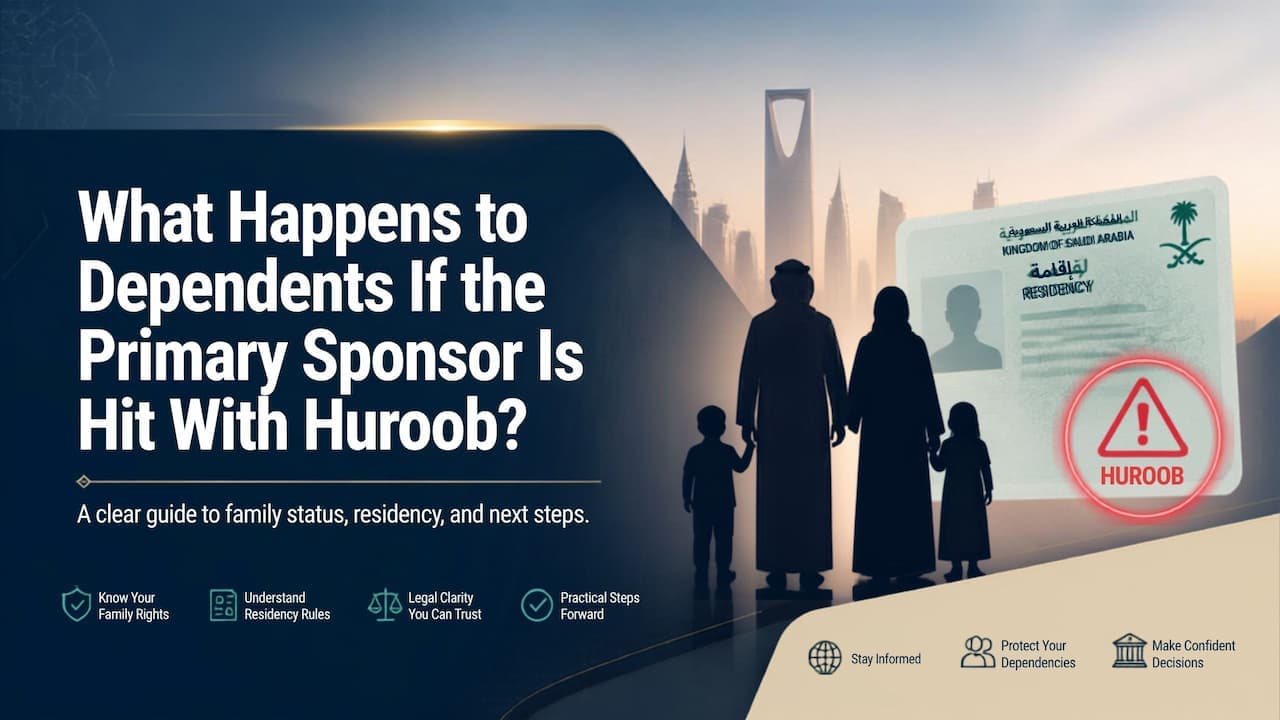
Saudi family's residency documents linked to a sponsor's Iqama status, representing dependents affected by a huroob report

When a primary sponsor in Saudi Arabia is reported as huroob (absconding), their dependents' Iqamas are generally affected too, since dependent residency is legally tied to the sponsor's own status under the Kafala system. Dependents typically cannot renew their Iqama, transfer sponsorship, or exit and re-enter normally until the sponsor's case is resolved.

AI Summary

This article explains what happens to a sponsor's dependents in Saudi Arabia when the primary Iqama holder is reported as huroob (absconding). Since dependent residency is legally tied to the sponsor's Iqama, a huroob report on the sponsor typically freezes dependents' status too, blocking renewals, exit/re-entry, and new services until the sponsor's case is resolved through transfer, final exit, or cancellation.

Generated by AI Β· Not legal advice

Key Takeaways
  • Dependent Iqamas are legally linked to the primary sponsor's residency status, so a huroob report against the sponsor generally freezes the dependents' status as well.
  • Dependents typically cannot renew their Iqama, transfer sponsorship, or exit/re-enter normally while the sponsor's huroob case is unresolved.
  • The sponsor has a 60-day grace period to resolve the huroob report (via sponsorship transfer or final exit) before it converts to a formal absconding record, which also affects dependents.
  • Dependents should check their own status via Absher alongside the sponsor's, since a resolved huroob case does not always automatically clear a lingering flag on dependent files.

Why Dependent Status Is Tied to the Sponsor

Under Saudi Arabia's Kafala sponsorship system, a dependent's residency permit exists as a sub-record under the primary sponsor's file, not as an independent status. When the sponsor's own residency record is flagged - whether for an expired Iqama, a huroob report, or another administrative issue - the linked dependent records are commonly frozen or restricted as a direct consequence, even though the dependents themselves have done nothing wrong.

The 60-Day Window and What It Means for Dependents

Under current MHRSD practice, an employer's huroob report does not immediately create an irrevocable status - the sponsor is generally granted a 60-day grace period to rectify the situation, either by transferring sponsorship (Tanazul) via Qiwa to a new employer or by securing a Final Exit visa to leave voluntarily. If no action is taken within that window, the status converts to a formal absconding record, leading to Iqama cancellation for the sponsor - and by extension, further complications for any dependents still linked to that file.

What Dependents Can Do

  • Check both the sponsor's and their own status independently through Absher using the relevant Iqama or border number
  • If the huroob report is disputed as false, pursue cancellation through HRSD alongside the sponsor rather than waiting passively
  • Avoid attempting to travel or renew documents until the sponsor's case is confirmed resolved, since a pending case can block exit even for dependents
  • Seek legal advice promptly where the family's residency is at risk, given how quickly the 60-day window can pass

For the resolution process itself, see our guide on suing an employer for a false huroob report and cancelling it through HRSD.

Key Takeaways

  • A huroob report against a sponsor generally freezes linked dependents' Iqama status as well.
  • A 60-day grace period exists to resolve the report before it becomes a formal absconding record.
  • Dependents should check their own status through Absher rather than assume it mirrors the sponsor's automatically.

Conclusion

A huroob report is rarely just the sponsor's problem - because dependent residency is structurally tied to the sponsor's file, the family's status is at risk the moment a report is filed. Acting within the 60-day window, checking everyone's status independently, and seeking legal help early are the most reliable ways to prevent a resolvable situation from becoming a permanent one.

Questions This Article Answers

SA
About the Author
Sara Al Mansoori
Senior Legal Analyst

Sara Al Mansoori is a Senior Legal Analyst at Wirestork with over nine years of experience researching UAE federal legislation, DIFC court procedures, and GCC employment disputes. She specialises in travel ban regulations, labour dispute resolution, and immigration compliance across the Emirates.