
Are you or your company wanted internationally?Check Now β†’
Wirestork logo
Services
Share
Homeβ€ΊBlogβ€ΊSaudi Law
Saudi LawLegal Q&A

What Happens If My Iqama Expires Outside Saudi Arabia?

KA
Khalid Al Rashidi
Saudi Arabia Legal Research Lead
|
22 July 2026Β·2 min read
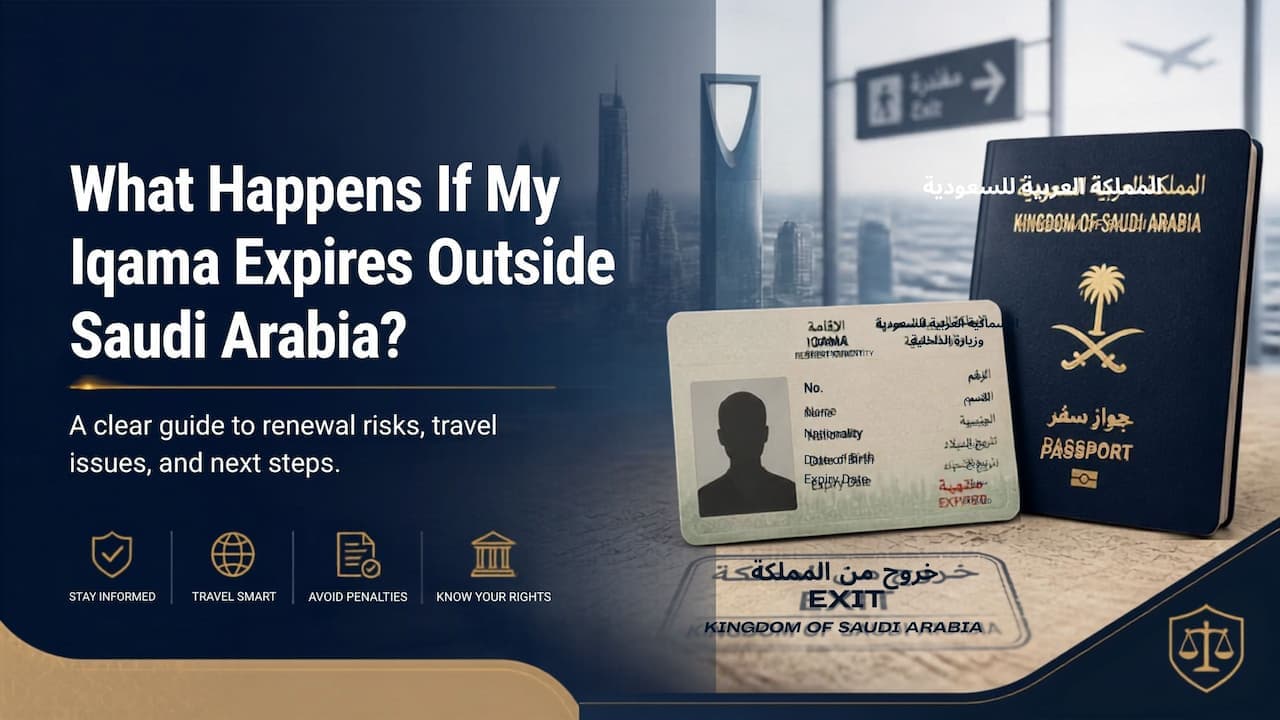
Illustration of a Saudi Iqama and passport with an expired stamp beside an airport re-entry gate

If your Iqama expires while you're outside Saudi Arabia, whether you can re-enter smoothly depends mainly on whether your exit/re-entry visa is still valid and whether your sponsor has renewed the Iqama in your absence. An expired Iqama alone doesn't automatically ban you, but it can delay or block re-entry until the renewal is sorted out, so checking your status before you travel back is essential.

AI Summary

This article explains what happens if a resident's Iqama expires while they are outside Saudi Arabia, covering the difference between an Iqama expiring during an approved exit/re-entry period versus during an unresolved absence, the risks to re-entry and sponsorship status, and the steps to resolve an expired Iqama before attempting to return.

Generated by AI Β· Not legal advice

Key Takeaways
  • An Iqama expiring while its holder is abroad on an approved exit/re-entry visa is generally a renewal issue to resolve before or upon return, not an automatic ban.
  • Re-entry can be refused or complicated if the Iqama has expired and not been renewed within the permitted exit/re-entry window, especially if the exit/re-entry visa itself has also lapsed.
  • Employers are generally responsible for renewing an employee's Iqama, but the employee should not assume this has happened while abroad - checking status via Absher before booking return travel is essential.
  • If both the Iqama and the exit/re-entry visa expire while abroad, the situation typically needs to be resolved through the sponsor or a new visa application before travel back to Saudi Arabia is possible.

Two Different Scenarios

There's an important distinction between the Iqama (residency permit) and the exit/re-entry visa (the permission to leave and come back). It's possible for the Iqama to expire while the exit/re-entry visa itself is still valid, in which case the practical fix is usually renewing the Iqama - often something your sponsor can do remotely, or that you complete promptly on return. It's a more serious situation if both the Iqama and the exit/re-entry visa have expired, since neither document authorizing your presence or return remains valid.

Who Is Responsible for Renewal

Iqama renewal is generally an administrative responsibility your employer or sponsor handles, often through the Muqeem or Absher platforms. That said, employees should never assume renewal has happened automatically simply because it's the employer's job - checking your own status independently before booking return travel avoids an unpleasant surprise at the airport or border.

Steps to Take Before Returning

  1. Check your Iqama and exit/re-entry visa status through Absher before finalizing any return travel
  2. Contact your sponsor or HR department directly to confirm whether the renewal has been processed
  3. If the Iqama has lapsed, request that your sponsor complete the renewal before you attempt to re-enter
  4. If the exit/re-entry visa has also expired, coordinate with your sponsor on next steps, since a fresh visa or entry authorization may be needed

For related passport-expiry scenarios on an exit/re-entry visa, see our guide on what happens if your passport expires on an exit re-entry visa.

Key Takeaways

  • An expired Iqama alone doesn't automatically bar re-entry, but it can delay or block it until renewed.
  • Renewal is typically the sponsor's responsibility, but employees should verify independently before travel.
  • Both the Iqama and exit/re-entry visa expiring together is a more serious situation requiring sponsor coordination.

Conclusion

An Iqama lapsing while you're abroad is a fixable administrative problem in most cases, but it needs to be caught and resolved before you attempt to travel back - not discovered at the airport. Checking your status through Absher and confirming with your sponsor ahead of time is the simplest way to avoid a blocked or delayed re-entry.

Questions This Article Answers

KA
About the Author
Khalid Al Rashidi
Saudi Arabia Legal Research Lead

Khalid Al Rashidi leads legal research operations at Wirestork covering the Kingdom of Saudi Arabia and broader GCC jurisdictions. With a dual background in Sharia and civil law, he has spent over eleven years analysing Royal Decrees, Jawazat travel ban regulations, and Saudi Ministry of Human Resources directives.