
Are you or your company wanted internationally?Check Now β†’
Wirestork logo
Services
Share
Homeβ€ΊBlogβ€ΊEmployment Law Saudi
Employment Law SaudiLegal Q&A

What Are the Probation Period Laws Under Saudi Labor Code?

JW
James Whitfield
International Legal Analyst
|
24 July 2026Β·2 min read
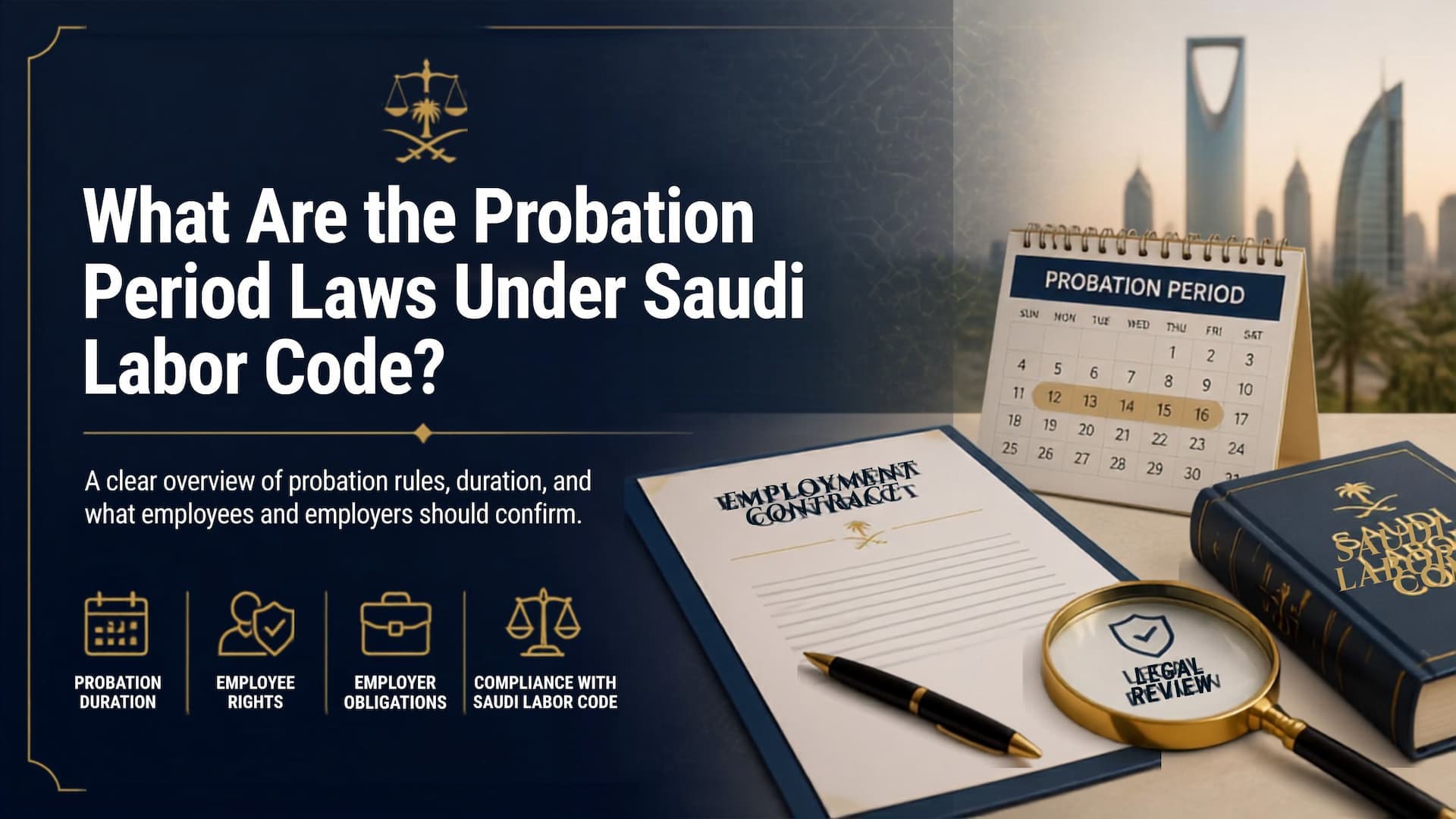
Employee and employer reviewing probation period terms under Saudi labor law

Saudi Arabia's Labor Code sets a standard probation period, commonly cited as 90 days, which can generally be extended by written agreement up to a further defined limit. During this period, both employer and employee typically have more flexibility to end the employment relationship than they would afterward.

AI Summary

This article explains the probation period rules under Saudi Arabia's Labor Code, covering the standard maximum duration, the possibility of extension by agreement, and the more flexible termination rights available to both employer and employee during this period compared to after it ends.

Generated by AI Β· Not legal advice

Key Takeaways
  • Saudi Labor Law generally sets a standard maximum probation period, commonly cited as 90 days, which can be extended by written agreement between employer and employee up to a further defined limit.
  • During probation, either party generally has more flexibility to end the employment relationship without triggering the same notice and compensation obligations that apply after probation ends.
  • An employee can generally only be placed on probation once with the same employer, preventing repeated probation periods for the same role.
  • Reviewing the specific probation terms in your Qiwa contract is important, since the exact duration and extension terms should be clearly stated there.

The Standard Probation Period

The Labor Law generally establishes a default probation duration for new employment relationships, giving both parties time to assess whether the role is a good fit before the fuller set of termination protections and notice requirements applies. The exact duration should always be confirmed against your specific Qiwa-registered contract, since this is where the applicable terms are formally documented.

Extending the Probation Period

An extension of the standard probation period is generally possible where both employer and employee agree in writing, up to a further defined limit beyond the initial period. An extension imposed unilaterally, without genuine agreement, is more likely to be challenged if disputed.

Termination Flexibility During Probation

One of the key features of the probation period is that either party generally has more flexibility to end the employment relationship without the same notice period or compensation obligations that apply to a standard termination after probation has concluded. This reflects the trial nature of the arrangement.

The One-Probation Rule

An employee generally cannot be placed on probation more than once with the same employer for the same role, preventing an employer from repeatedly resetting the probation clock to avoid full employment protections.

Key Takeaways

  • The standard probation period is commonly cited as 90 days, confirmable against your Qiwa contract.
  • Extension generally requires written agreement between both parties.
  • Termination during probation is generally more flexible than after it ends.
  • An employee generally can't be placed on probation more than once for the same role with the same employer.

Conclusion

The probation period gives both employer and employee a defined, lower-stakes window to assess fit before the full weight of the Labor Law's termination protections applies. Knowing your specific probation length and terms - straight from your Qiwa contract - is the best way to understand exactly where you stand.

Questions This Article Answers

JW
About the Author
James Whitfield
International Legal Analyst

James Whitfield is Wirestork international legal analyst focusing on DIFC Courts jurisprudence, ADGM regulations, and common law principles within the UAE financial free zones. He holds an LLM in International Arbitration from the National University of Singapore.