
Are you or your company wanted internationally?Check Now β†’
Wirestork logo
Services
Share
Homeβ€ΊBlogβ€ΊEmployment Law Saudi
Employment Law SaudiLegal Q&A

What Are the Weekly Rest Day and Overtime Laws in KSA?

MW
Martin Walbourgh
Director of Strategic Partnerships
|
24 July 2026Β·2 min read
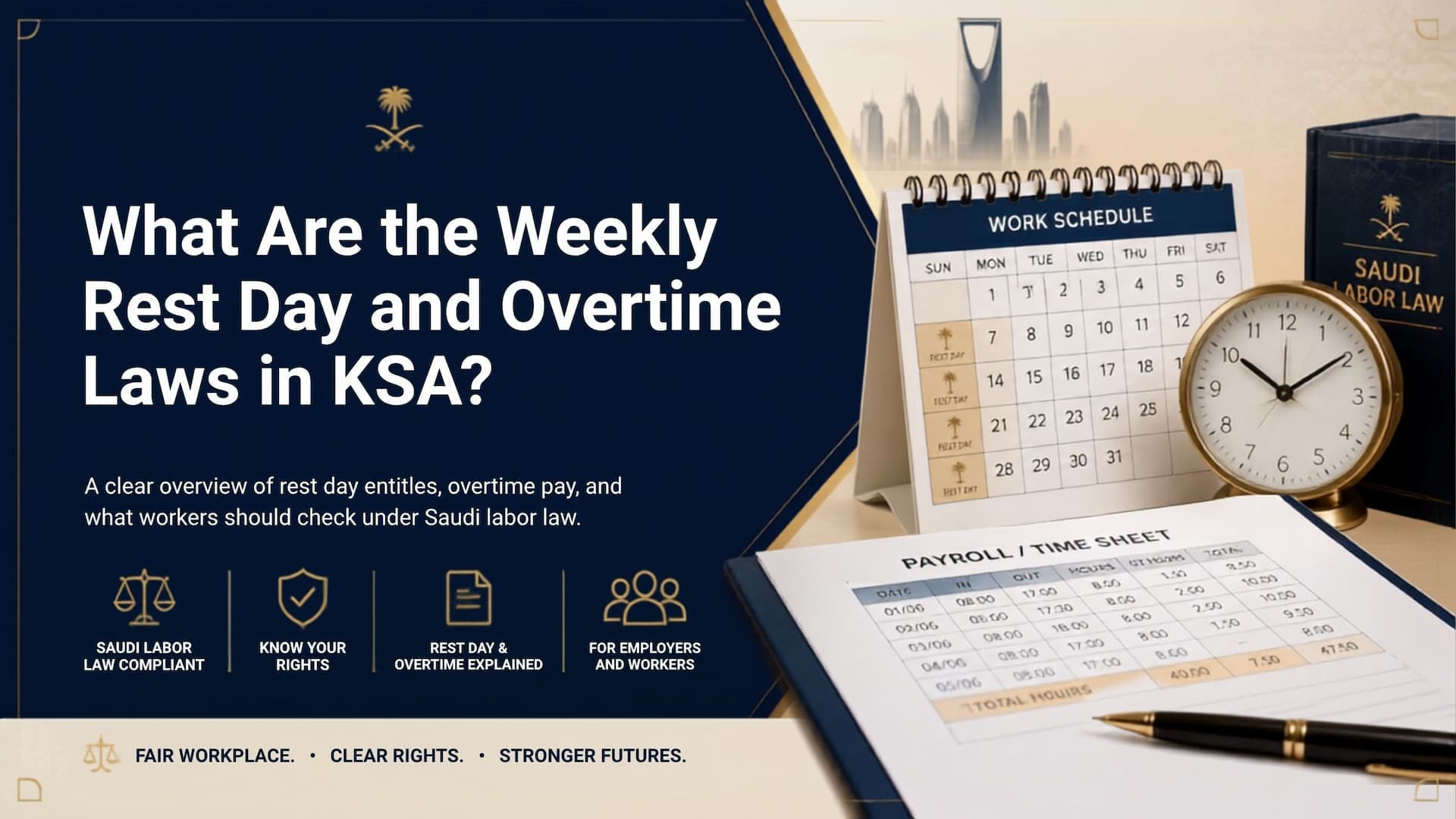
Employee reviewing weekly rest day and overtime pay rules under Saudi labor law

Saudi labor law generally entitles employees to a minimum of one paid rest day per week - commonly Friday, though adjustable by the employer for operational reasons - and requires overtime hours to be compensated at a premium above the normal hourly wage.

AI Summary

This article explains the weekly rest day and overtime pay rules under Saudi Arabia's Labor Code, covering the standard rest day entitlement, when it can be adjusted, and how overtime compensation is generally calculated for hours worked beyond the standard workday or week.

Generated by AI Β· Not legal advice

Key Takeaways
  • Saudi labor law generally entitles employees to a minimum of one paid rest day per week, commonly falling on Friday, though this can be adjusted by the employer based on operational needs.
  • Overtime work - hours beyond the standard daily or weekly limit - is generally compensated at a premium rate above the employee's normal hourly wage.
  • Certain categories of employees or work arrangements may have different rest day or overtime rules, so checking your specific Qiwa contract terms against the general framework matters.
  • Employers who fail to properly compensate overtime or provide the required rest day can be the subject of a labor complaint through MHRSD.

The Weekly Rest Day

Employees are generally entitled to at least one full, paid rest day each week. While Friday is the customary default given the regional working week, employers can adjust which specific day is designated as the rest day based on genuine operational needs, particularly in sectors that operate continuously.

Standard Working Hours and Overtime

The Labor Law sets standard limits on daily and weekly working hours, and hours worked beyond those limits generally qualify as overtime, compensated at a premium rate above the employee's normal hourly wage rather than at the standard rate. During Ramadan, working hour limits for Muslim employees are generally reduced, which affects when overtime calculations begin.

Exceptions and Variations

Certain categories of work, seniority levels, or specific contractual arrangements can carry different rules around rest days and overtime, so the general framework should always be checked against your specific Qiwa contract terms rather than assumed to apply uniformly.

What to Do If These Rules Aren't Being Honored

  • Keep your own record of hours worked, including any overtime, separate from what your employer reports
  • Raise the issue directly with your employer or HR department first
  • File a labor complaint with MHRSD if the issue isn't resolved, using your own documented records as supporting evidence

Key Takeaways

  • Employees are generally entitled to at least one paid rest day per week.
  • Overtime hours beyond the standard limit are generally compensated at a premium rate.
  • Specific rules can vary by role, so check your Qiwa contract against the general framework.

Conclusion

Rest day and overtime rules exist to protect a basic standard of working conditions, and knowing them gives you a clear reference point if your actual working arrangement doesn't match up. Keeping your own hours record is the simplest thing you can do to protect yourself if a dispute ever arises.

Questions This Article Answers

MW
About the Author
Martin Walbourgh
Director of Strategic Partnerships

Martin Walbourgh is an online marketing strategist with over 17 years of hands-on experience in performance marketing, reputation management, and programmatic advertising. Currently serving as Director of Strategic Partnerships at Wirestork, Martin has built a career helping online brands recover lost revenue and strengthen their digital presence β€” working with notable names including H&M, Skagen, and Strauss. A Forbes contributor and alumnus of the London School of Economics, Martin's expertise spans SEO, brand marketing, lead generation, performance marketing, and online reputation