
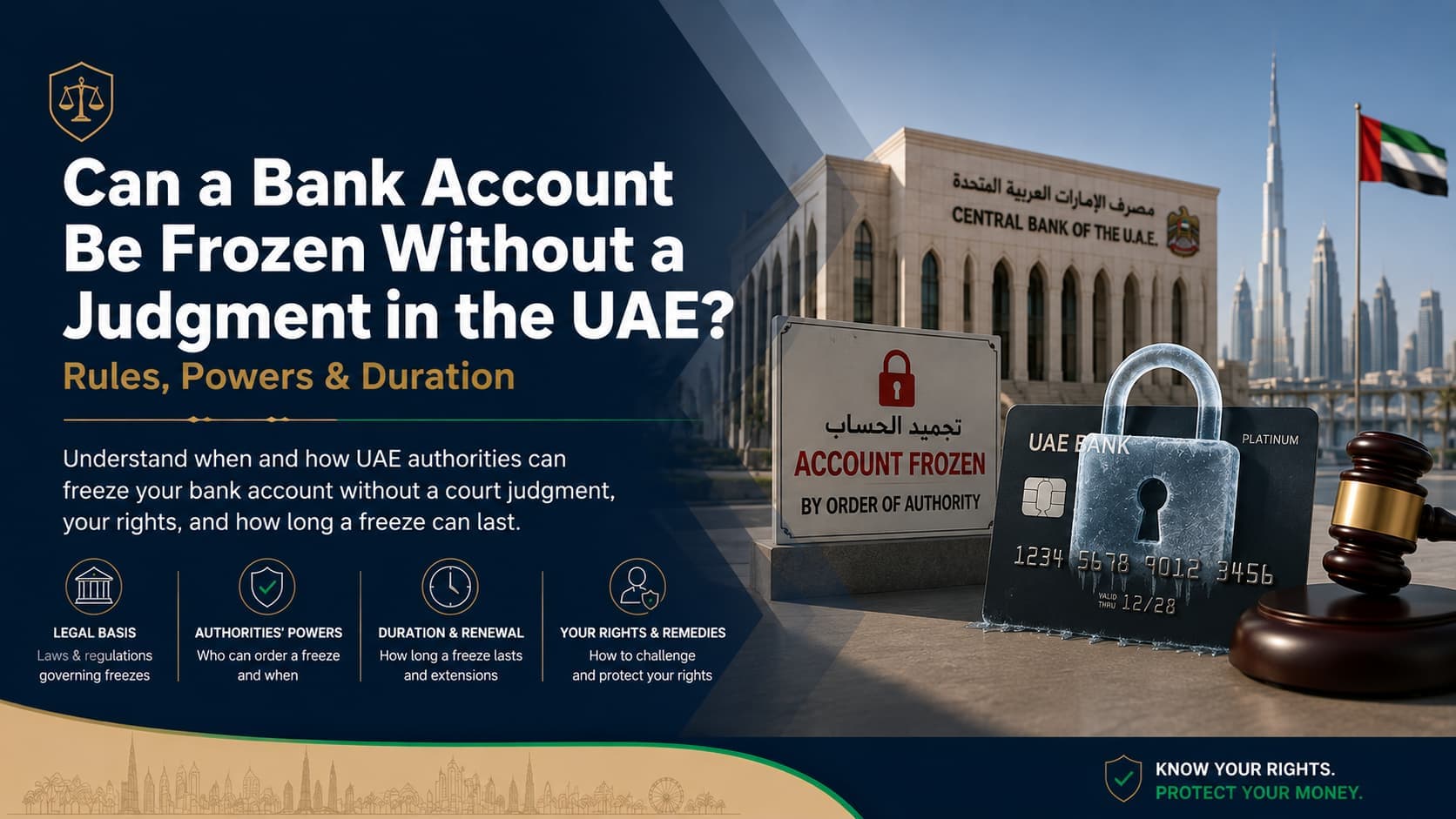
Few discoveries are more alarming than logging into your UAE banking app and finding your account restricted — salary inaccessible, transfers blocked, cards declined — with no judgment, no court hearing, and often no explanation from the bank at all. For expats accustomed to legal systems where a court judgment is a prerequisite for touching someone's funds, this raises an immediate and urgent question: can a bank account be frozen without a judgment in the UAE?
The short answer is yes, and it happens more often than most expats realize. The UAE's legal and regulatory framework gives courts, financial intelligence authorities, and even banks themselves several distinct routes to restrict an account long before any final ruling is issued. This guide walks through exactly which mechanisms allow a pre-judgment freeze, what legal thresholds each one requires, how long the restriction can legally last, and what steps you can take to challenge or lift it.
Quick Takeaways
- Yes, a bank account can be frozen in the UAE without a final judgment, through a precautionary attachment, an AML/FIU freeze, a bank-led compliance hold, or a criminal investigation order.
- Precautionary attachment (Article 247, Federal Decree-Law No. 42 of 2022) lets a creditor freeze your account before a case is decided, provided they show an official, due, and liquidated debt.
- FIU freezes under Federal Decree-Law No. 10 of 2025 can last up to 30 days, extendable by the Attorney General, and the bank cannot lift them on its own.
- You generally have 7 days to formally object to a precautionary attachment once notified.
- Creditors must post an indemnity undertaking before a precautionary freeze is granted, their exposure if the freeze turns out to be unjustified.
- Not all freezes come from courts. Many stem from AML compliance, sanctions screening, or visa cancellation, and follow entirely different rules and timelines.
- Duration varies enormously by freeze type, from 7 to 10 working days for urgent FIU suspensions, to 30 days for FIU freezes, to "until the case is resolved" for court-ordered precautionary attachments.
The Short Answer: Yes, But Through Several Different Routes
It's a common misconception that a bank account freeze always means a court has already ruled against you. In reality, a UAE bank account can be frozen through at least four distinct legal pathways, each triggered by a different authority, governed by a different law, and subject to different timelines: precautionary attachment, a civil court order obtained by a creditor before or during a lawsuit; FIU/AML freeze, a regulatory freeze ordered by the Financial Intelligence Unit over suspected financial crime; bank-led compliance hold, the bank's own internal action under its anti-money-laundering obligations; and criminal investigation freeze, an order tied to an active police or prosecutorial investigation.
Understanding which category applies to your situation is the single most important first step, because these categories look identical from the account holder's side but require entirely different responses to resolve.
Route 1: Precautionary Attachment — Freezing Funds Before a Judgment
The Legal Basis
The most common pre-judgment freeze mechanism is the precautionary attachment, governed by Article 247 of Federal Decree-Law No. 42 of 2022 (the UAE Civil Procedure Law), which replaced the older Federal Law No. 11 of 1992 and took effect on January 2, 2023. Under Article 247, a creditor can apply to a summary judge for an order to provisionally attach a debtor's assets, including bank account balances, to secure a monetary claim, without needing to wait for a final judgment in the underlying case.
What a Creditor Must Show
To succeed, the applying creditor generally needs to demonstrate an official, due, and liquidated debt, meaning the amount owed is clear, undisputed in principle, and currently payable; a genuine risk that the debtor might transfer, hide, or dissipate assets before a judgment can be enforced; and urgency, in many cases, particularly where the application is made before a main lawsuit has even been filed.
If the court is satisfied, it can issue the freeze order remarkably quickly, in urgent cases, within 24 to 48 hours of the application being made, and often without any prior notice to the account holder, precisely because advance warning would defeat the purpose of preventing asset dissipation.
The Creditor's Exposure: The Indemnity Undertaking
One protection built into this system that often surprises expats is that the creditor doesn't get this power for free. Before a precautionary attachment is granted, the applying creditor must provide an indemnity undertaking, essentially a formal promise to compensate the account holder for damages if the freeze later turns out to have been unjustified, for example if the creditor ultimately loses the main case. This is one of the built-in checks against creditors weaponizing the freeze mechanism purely for leverage.
Scope: It Can Reach Accounts at Other Banks Entirely
A detail that catches many expats off guard is that a precautionary attachment isn't limited to the account directly involved in a dispute. Courts can order a freeze across any bank account held in your name anywhere in the UAE, even if the underlying claim, commonly a bounced cheque, originated with a completely different bank. Once the order is issued, it's transmitted through the UAE Central Bank, and every bank where you hold funds is legally obligated to comply immediately upon notification. For a full breakdown of how creditors obtain these orders, including travel bans and other precautionary measures, see our guide on UAE creditor precautionary measures.
Route 2: FIU and AML Freezes — Regulatory Action Without Any Court Hearing
The Legal Basis
Separately from civil court freezes, the UAE's anti-money-laundering framework, most recently updated under Federal Decree-Law No. 10 of 2025, gives the Financial Intelligence Unit (FIU) significant independent power to suspend or freeze funds, entirely outside the civil court system, whenever a Suspicious Transaction Report (STR) has been filed and analyzed.
How This Works in Practice
- The Chief of the FIU may, without prior notice, order the cessation or temporary suspension of any transaction suspected of being linked to a crime, for up to 10 working days.
- The Chief may also order the freezing of funds suspected of being related to a crime and held at a financial institution, for up to 30 days.
- These orders are subject to extension by the Attorney General or their delegate.
Critically, once an FIU freeze is in place, the bank itself has no discretion to lift it. Bank staff typically cannot provide specific documentation requirements to resolve the freeze, cannot give a clear timeline, and standard complaint escalation within the bank produces no movement, because only the FIU or the Attorney General can authorize release of the funds. If your account shows these characteristics, you're likely dealing with a regulatory freeze rather than a routine compliance hold. Our guide on bank accounts frozen for KYC or suspicious transaction flags walks through exactly how to tell the difference and what to do next.
Route 3: Bank-Led Compliance Holds — When the Bank Freezes Its Own Customer
Not Every Freeze Involves a Court or Regulator at All
The third major category is a freeze initiated entirely by the bank itself, acting on its own anti-money-laundering obligations under Federal Decree-Law No. 20 of 2018 on Anti-Money Laundering and Combating the Financing of Terrorism, together with its implementing Cabinet Decision. Here, no external authority has necessarily ordered anything, the bank has independently decided that a transaction pattern looks suspicious, or that your Know Your Customer (KYC) file is incomplete or outdated, and restricted the account pending internal review.
Why This Is Often the Most Frustrating Freeze to Resolve
Because this is an internal compliance action rather than a court order, account holders are often given the least information of any freeze category, and the bank is, in many cases, legally constrained in how much it can disclose about the reasoning. Common triggers include large or unusual incoming transfers, particularly from overseas; outdated Emirates ID, passport, or visa documentation on file; mismatches between declared occupation or income and actual account activity; and periodic sanctions-list screening flags.
Standard AML reviews of this kind typically resolve within 1 to 3 weeks with adequate supporting documentation, though more complex cases involving multiple jurisdictions can extend to 4 to 8 weeks.
Route 4: Criminal Investigation Freezes
Where a bank account is connected to an active criminal investigation, commonly fraud, embezzlement, or breach of trust allegations, the Public Prosecution can order funds frozen as part of the investigation itself, entirely independent of any civil judgment or even any formal charge yet being filed. Because this route sits within the criminal justice system rather than civil procedure, it follows the UAE Penal Code and Criminal Procedures Law rather than the Civil Procedure Law's precautionary attachment framework, and its duration is tied to the investigation's progress rather than a fixed statutory cap.
How Long Can a UAE Bank Account Stay Frozen Without a Judgment?
- Precautionary attachment: No fixed statutory cap. The freeze generally continues until the underlying case is resolved, whether through judgment, settlement, or withdrawal of the claim.
- FIU urgent suspension: Up to 10 working days.
- FIU freeze order: Up to 30 days, extendable by the Attorney General.
- Bank-led AML/compliance hold: Typically 1 to 3 weeks for standard reviews; 4 to 8 weeks for complex, multi-jurisdictional cases.
- Criminal investigation freeze: Tied to the investigation's timeline, potentially weeks to months, with no fixed statutory ceiling.
- Sanctions list false-positive freeze: The relevant office must decide on a request to lift the freeze within 30 days of receiving it, under the Central Bank's rulebook provisions on false positives.
If an account has been frozen for an extended period, commentators point specifically to cases stretching beyond a year, without clear notice or explanation, that is generally a strong signal to escalate through formal legal channels rather than continuing to wait on informal bank responses.
Your Rights: Notice, Objection, and Legal Recourse
The Right to Notice
For most freeze categories, you are legally entitled to be informed. Banks are generally required to notify the account holder of a freeze and the reason for it within a defined window after it takes effect, commonly cited as 48 hours in practice for bank-initiated actions, though FIU and precautionary attachment orders can be executed without any advance warning, precisely to prevent the account holder from moving funds first.
The Right to Object
Where a precautionary attachment has been issued, the debtor generally has a limited window, commonly around 7 days from notification, to file a formal objection challenging the freeze. This is a genuine, time-sensitive right, and missing this window can make it considerably harder to have the freeze reconsidered before the underlying case concludes.
What You Can Do at Each Stage
- Identify the type of freeze first: visit your branch and request an official copy of the freeze order, the issuing authority, and the case or reference number, since your entire strategy depends on getting this right before acting.
- For a precautionary attachment: engage a lawyer promptly to file a formal objection within the applicable window, or negotiate a settlement with the creditor to have the freeze released.
- For an FIU freeze: recognize that the bank cannot help you directly, your recourse runs through the FIU or Attorney General's office, typically via legal counsel.
- For a bank-led compliance hold: respond promptly and completely to any document requests, since incomplete responses are the single most common reason these freezes drag on longer than necessary.
- If a freeze is later found unjustified: where a precautionary attachment is lifted because the creditor's main case fails, you may have grounds to claim damages against the creditor's indemnity undertaking.
Practical Guidance for Expats Managing This Risk
Before Any Freeze Happens
- Keep your KYC documentation current: an expired Emirates ID or visa is one of the most common, avoidable triggers for a bank-led compliance freeze.
- Avoid leaving postdated cheques outstanding without tracking your balance against them, since bounced cheque disputes are one of the most frequent paths into a precautionary attachment.
- Understand your exposure across all UAE banks, not just the account directly involved in a dispute, since a single court order can reach every account in your name.
If You Discover a Freeze
- Don't assume the worst before confirming the category: a bank-led KYC hold and a precautionary attachment require completely different responses, and pursuing the wrong one wastes valuable time.
- Request written confirmation of the freeze's legal basis and issuing authority as your first step, always.
- Engage a UAE-qualified lawyer quickly, particularly if a court-ordered precautionary attachment is involved, given the short objection window.
- Maintain access to alternative funds where possible while the matter is resolved, since resolution timelines for complex cases can extend to weeks or months.
Frequently Asked Questions
Can a UAE bank freeze my account without any court order at all?
Yes. Banks can freeze accounts on their own initiative under their anti-money-laundering compliance obligations, entirely independent of any court or regulatory order, commonly triggered by outdated KYC documentation, unusual transaction patterns, or sanctions-screening flags.
How long can a precautionary attachment freeze my account before a judgment is reached?
There is no fixed statutory cap. A precautionary attachment under Article 247 of Federal Decree-Law No. 42 of 2022 generally remains in place until the underlying case is resolved through judgment, settlement, or withdrawal of the claim, which can take anywhere from weeks to many months depending on the case's complexity.
Can I get compensation if my account was frozen unfairly?
Potentially, yes. A creditor seeking a precautionary attachment must provide an indemnity undertaking before the freeze is granted. If the creditor's main case ultimately fails and the attachment is found to have been unjustified, you may have grounds to claim damages against that undertaking.
What's the difference between an FIU freeze and a bank-led compliance freeze?
An FIU freeze is a formal regulatory order issued by the Financial Intelligence Unit following a Suspicious Transaction Report, and only the FIU or Attorney General can lift it, the bank has no discretion. A bank-led compliance freeze is an internal decision by the bank itself under its own AML obligations, and the bank can typically resolve it once you provide the requested documentation.
Can a court freeze my account at a completely different bank than the one involved in my dispute?
Yes. A precautionary attachment order transmitted through the UAE Central Bank can reach any bank account held in your name anywhere in the UAE, regardless of which bank was originally involved in the underlying dispute, commonly seen in bounced cheque cases that reach the execution stage.
Getting the Right Support
Because a frozen UAE bank account can stem from at least four legally distinct mechanisms, each with its own governing law, evidentiary threshold, and timeline, correctly diagnosing which one applies to your situation before you act is essential. Acting on the wrong assumption, such as treating a precautionary attachment like a routine KYC hold, can cost you the narrow window you have to formally object. If you're facing a frozen account in the UAE, consulting a lawyer experienced in both civil enforcement and banking compliance early gives you the best chance of resolving the freeze quickly and, where appropriate, challenging it before the underlying dispute is even decided.
Recover your debt
Recover outstanding payments through legal debt-collection.
Recover Your DebtSara Al Mansoori is a Senior Legal Analyst at Wirestork with over nine years of experience researching UAE federal legislation, DIFC court procedures, and GCC employment disputes. She specialises in travel ban regulations, labour dispute resolution, and immigration compliance across the Emirates.
Share this article
Stay informed.
Receive important legal and regulatory updates across the UAE, Saudi Arabia and the wider GCC.
No spam. Unsubscribe anytime.
Continue Reading
More Legal Insights
UAE Unlimited Contract Abolished: What It Means for Employers and Employees in 2026
UAE unlimited employment contracts were abolished by Federal Decree-Law No. 33 of 2021, ef…
Saudi Work Permit Cancelled After 3 Months' Absence (2026 Qiwa Rule)
From June 30, 2026, Saudi Arabia automatically cancels Qiwa registration for non-Saudi wor…
Qiwa Contract Limit 2026 & Saudi Work Visa Quotas: Nitaqat Overhaul Explained
The Qiwa platform caps Saudi nationals at seven employment contracts per year and two simu…