
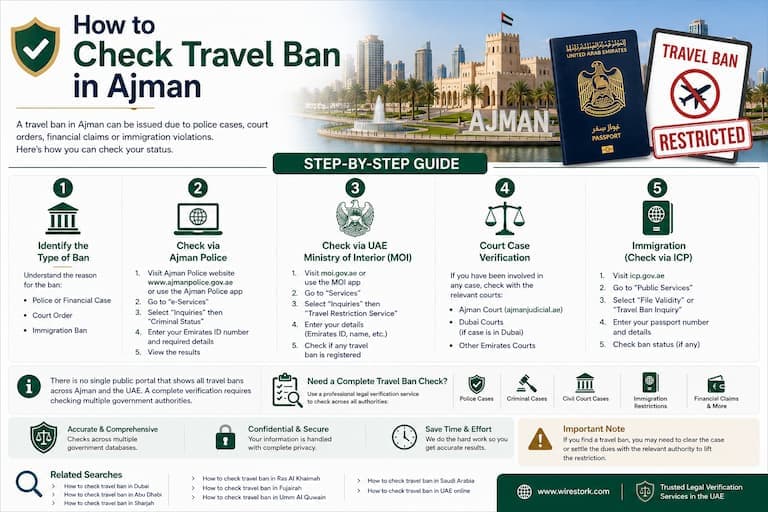
In Ajman, the question of whether a person is legally free to leave the UAE is answered through a statute. Travel bans in Ajman are not an administrative flag sitting in a searchable database; they are precautionary or executory measures issued under Federal Decree-Law No. 42 of 2022 — the UAE's Civil Procedures Law, in force since January 2023 — or under a parallel criminal or immigration process. That legal architecture, more than any technical gap, is why Ajman has no single portal a resident can check from a phone.
This piece sets out, with reference to the underlying law rather than just the paperwork, how a Sharjah- or Ajman-style travel ban actually arises, the verification channels genuinely open to residents, and the statutory conditions that govern when a ban is lifted. Where relevant, it draws on Ajman Police procedure, the ICP Federal Authority, and the UAE's federal government portal.
This guide explains the statutory basis for travel bans in Ajman, grounding the explainer in Federal Decree-Law No. 42 of 2022 (UAE Civil Procedures Law) rather than treating the ban as a generic administrative flag. It covers Articles 324–327 governing civil travel ban orders (the AED 10,000 debt threshold, ex-parte issuance, and automatic lapse conditions), distinguishes the civil/criminal track (Execution Court, Public Prosecution, Ajman Police) from the immigration track (ICP Smart Services), and sets out four verification routes, required documentation, and the precise statutory conditions for lifting a ban. It also explains why travel bans apply federally regardless of the issuing emirate.
Generated by AI · Not legal advice
- Civil travel bans in Ajman are issued under Articles 324–327 of Federal Decree-Law No. 42 of 2022, not a standalone travel-ban law.
- Ajman has no dedicated online portal for a court- or police-issued travel ban; ICP Smart Services covers only federal visa and residency status.
- Civil bans generally require a debt of at least AED 10,000 and can be granted ex parte, before the debtor is notified.
- A ban lapses automatically if the creditor doesn't file suit within 8 days, doesn't enforce judgment within 30 days, or takes no execution step for 3 years.
- Passport-number checks for a specific Ajman case generally require a licensed lawyer.
- Travel bans are federal — an Ajman-issued ban applies at every UAE airport.
- A ban does not lift automatically on payment; Article 325 requires written creditor consent, a court-accepted guarantee, or confirmed judgment satisfaction.
Key Takeaways
- A civil travel ban in Ajman Emirate is issued under Articles 324–327 of Federal Decree-Law No. 42 of 2022, not through a standalone "travel ban law" — it is an execution or precautionary tool attached to a debt or judgment.
- Ajman has no dedicated online portal for a court- or police-issued travel ban check; ICP Smart Services covers federal visa and residency status only.
- Civil bans generally require a debt of at least AED 10,000, excluding maintenance and wage claims, and can be issued ex parte — before the debtor is notified.
- A passport-number inquiry into a specific Ajman case generally requires a licensed lawyer, since the emirate has no self-service lookup.
- Under the same law, a ban lapses if the creditor fails to file the underlying lawsuit within eight days, fails to enforce judgment within 30 days, or takes no execution step for three years.
- Travel bans are federal instruments — a restriction filed in Ajman is enforced at every UAE airport.
- Because the legal framework is precise but the reporting infrastructure is not, verification through more than one channel remains the safest course.
The Legal Basis for a Travel Ban — and Why Ajman's Process Looks Different
A UAE travel ban is not a single, codified offense; it is a procedural remedy attached to an underlying civil, criminal, or immigration matter. In civil cases, the operative law is Federal Decree-Law No. 42 of 2022 on Civil Procedures, which replaced the older Federal Law No. 11 of 1992 framework (as amended by Cabinet Decision No. 57 of 2018). Under Article 324, a creditor with serious grounds to believe a debtor intends to leave the UAE without settling a debt can petition an Execution Judge for a travel ban — before or after filing the main lawsuit — provided the debt is at least AED 10,000, is fixed and due, and is supported by written evidence. Because the order can be granted ex parte, a debtor may have a ban in place before ever receiving formal notice of the claim.
Articles 325 through 327 govern how long the ban lasts and how it ends: it remains in force until the obligation is settled, the creditor agrees in writing to lift it, or the debtor posts an acceptable bank guarantee — and it lapses automatically if the creditor doesn't file the main claim within eight days of obtaining the ban, doesn't pursue enforcement within 30 days of a final judgment, or lets three years pass without further execution steps. A separate track applies to criminal matters, where a ban typically attaches to an open investigation or an unresolved cheque-related complaint under the Commercial Transactions Law, and to immigration matters, which fall outside the Civil Procedures Law entirely and are handled by the UAE's official government portal's framework and the ICP Federal Authority.
None of this statutory machinery is publicly searchable by case number in Ajman. Ajman, like Sharjah, Fujairah, Ras Al Khaimah, and Umm Al Quwain, has not extended that same public interface to its Execution Court or Public Prosecution records. What residents do have is ICP Smart Services, the platform run by the Federal Authority for Identity, Citizenship, Customs and Port Security, which confirms visa validity and residency status — a genuinely federal, genuinely useful check, but one that sits outside the Civil Procedures Law entirely and will not surface an Article 324 ban tied to a private debt dispute.
What Typically Triggers a Ban in Ajman
Legal practitioners handling these cases in the Northern Emirates point to a consistent set of triggers, each mapped to a distinct legal track:
- Unpaid debts meeting the AED 10,000 threshold under Article 324 — the most common civil trigger.
- Dishonoured cheques, which under Article 667 of the Civil Procedures Law convert into an enforceable writ of execution once returned unpaid.
- Open criminal investigations, where a ban can precede formal charges.
- Labor disputes, typically filed by an employer alleging an employee has absconded, or by an employee pursuing unpaid dues.
- Family and custody matters, most often tied to alimony or child-support arrears — claims specifically carved out of the AED 10,000 minimum.
A detail practitioners flag repeatedly: settling the debt informally does not extinguish the ban. Under Article 325, the ban lifts only on the creditor's written consent, the court's acceptance of a guarantee, or confirmed satisfaction of the judgment — not on a verbal assurance that money has changed hands. Ending an Ajman tenancy agreement, for instance, does not by itself close out a related claim; a court case status check is the only reliable way to confirm whether the underlying filing has actually been closed.
How to Check Your Travel Ban Status in Ajman: Four Verification Routes
1. Visit an Ajman Police Station or the CID
For a criminal-track ban, or where the origin of the restriction is unclear, an in-person inquiry remains the most direct method. Ajman, together with Sharjah, Ras Al Khaimah, Fujairah, and Umm Al Quwain, requires residents to approach the originating authority directly: a civil execution matter is properly handled through the Public Prosecution or Execution Court channel, while a police-registered complaint is raised at Ajman Police. Bring an Emirates ID and passport, and specify the Criminal Investigation Department (CID) if the matter is believed to be police-related rather than civil. A preliminary police case check can help identify which office holds the relevant file.
2. Use ICP Smart Services for a Federal Immigration Check
The ICP Smart Services portal lets Ajman residents check visa validity, residency status, and file status by passport or Emirates ID number. It is a legitimate first step for immigration-track concerns, but because it operates outside the Civil Procedures Law, it will not reflect an Article 324 ban tied to a private debt or judgment. A clear ICP result confirms immigration standing — it does not confirm the absence of a civil or criminal travel ban.
3. Engage a Licensed UAE Lawyer
Given the ex-parte nature of civil travel ban orders — a debtor may not be notified before one is issued — legal counsel is often the only practical way to confirm whether an Article 324 order exists against a specific person. Because Ajman, Sharjah, Ras Al Khaimah, and Al Ain offer no self-service court lookup by passport number, a case inquiry by passport number is generally conducted through counsel, who can search Execution Court and Public Prosecution records directly. A lawyer can also obtain full case details on a client's behalf under a Power of Attorney, which matters for anyone currently outside the UAE and unwilling to test the ban by attempting to fly back.
4. Consult the Federal U.AE Government Portal
This will not return Ajman-specific case data, but the official government portal sets out the general federal framework for travel restrictions and is useful for identifying which authority — the Execution Court, Public Prosecution, or ICP — is likely to hold the relevant record.
Documentation Required for an Ajman Travel Ban Inquiry
- A valid Emirates ID (original and copy)
- Passport (original and copy)
- Visa or residency permit, carrying the UID number referenced by ICP Smart Services
- Any existing case or complaint reference number, ideally the Execution Court file number if one exists
- A Power of Attorney, where a lawyer is inquiring on a resident's behalf
A case number materially speeds resolution, since Execution Court files are indexed by number rather than by name alone. Without one, a station visit or a court and police case check service can still proceed, but the search will take longer.
Lifting a Travel Ban: The Statutory Conditions
Article 325 sets out a narrow, specific list of conditions under which a civil travel ban ends: full satisfaction of the underlying debt, the creditor's written agreement to lift it, or the debtor's provision of a bank guarantee or acceptable surety. The same article provides for automatic lapse in three circumstances — no lawsuit filed within eight days of the ban being granted, no enforcement action within 30 days of a final judgment, or three years passing with no further execution steps. A criminal-track ban typically ends when the underlying complaint is withdrawn or the case is formally closed by the Public Prosecution.
None of these events removes the ban automatically from every downstream system. Advisers who handle these cases routinely note that a ban can persist in border-control records even after the Execution Court has, on paper, released it — which is why written confirmation from the court or prosecution, not a verbal assurance, should be treated as the operative proof before booking travel.
Ajman Compared With Other Emirates
The list below sets out how Ajman's verification options compare with the rest of the UAE:
- Dubai — full self-service online check via the Dubai Police website/app and the Amer service.
- Abu Dhabi — full self-service online check via the Abu Dhabi Judicial Department's Estafser portal.
- Ajman — partial: ICP Smart Services for immigration status; police station, CID, or a lawyer required for Article 324 civil/criminal cases.
- Sharjah — no online option; Sharjah Police, CID, or the Public Prosecution app only.
- Ras Al Khaimah / Umm Al Quwain — no online option; Public Prosecution (07 2070000) or a police station visit.
The disparity is instructive: a genuine self-service UAE immigration ban check onlineexists only in Dubai and Abu Dhabi, where the underlying execution and criminal-case databases are directly exposed to a public interface. Ajman's position is narrower than it first appears: ICP addresses immigration status, not Article 324 civil orders, which is why a confidential lawyer-verified check remains the more complete route.
The Consequences of Traveling With an Active Ban
A travel ban, once entered into the federal border-control system, applies uniformly — it is not confined to the airport nearest to where it was issued. Immigration officers at any UAE exit port will flag an Ajman-originated ban regardless of whether the traveler is departing from Dubai International or Abu Dhabi International, because the underlying order is circulated to all exit points as a matter of procedure under the Civil Procedures Law's execution rules.
The colloquial term for this outcome is a "red light" — a designation that ranges from a short delay while officials confirm the underlying order, to formal detention over an immigration matter or an unresolved criminal complaint, depending on severity. It is this asymmetry — a routine administrative check versus a serious legal escalation — that makes advance verification, rather than discovery at passport control, the more defensible course.
Reducing the Risk of a Future Travel Ban
- Insist on written settlement documentation. Under Article 325, only a creditor's written consent lifts a ban — a verbal agreement carries no legal weight.
- Respond to legal notices promptly. Because civil bans can be granted ex parte, silence does not protect a debtor; it simply delays the point at which they learn of the order.
- Close out tenancy and employment matters formally, including final settlements and termination paperwork — a court case status check can confirm no related filing remains open.
- Retain every clearance document indefinitely, since border-control records do not always update automatically once a court file is closed.
- Verify status before booking non-refundable travel, particularly following any recent financial or legal dispute in the emirate.
Conclusion
An Ajman travel ban is not an administrative quirk; it is the operation of a specific statute — Federal Decree-Law No. 42 of 2022 — applied through a Public Prosecution or Execution Court process that has not been extended to a public self-service interface. ICP Smart Services closes part of that gap for immigration-status questions, but it does not reach the Article 324 civil orders or criminal complaints that account for most Ajman travel bans. The realistic path to a complete answer remains a visit to the police station or CID, or engagement of counsel who can search Execution Court and Public Prosecution records directly and, where needed, inquire on a client's behalf while they remain abroad.
Because these orders are enforced federally, a case opened in Ajman will surface at any UAE airport — a fact that makes advance verification a matter of legal prudence rather than mere caution. Anyone with reason to suspect an outstanding debt, an unresolved criminal complaint, or a lingering civil claim should confirm their status well ahead of booking travel, and should treat only written confirmation from the court or prosecution — not a verbal assurance — as proof that a ban has actually lifted.
For residents uncertain where to begin, the most reliable starting point is a confidential, lawyer-verified UAE travel ban check, which can confirm status across all seven emirates, identify the governing statute behind the restriction, and set out the specific steps required to have it lifted.
References
- Federal Authority for Identity, Citizenship, Customs and Port Security — icp.gov.ae
- Ajman Police General Headquarters — ajmanpolice.gov.ae
- The Official Portal of the UAE Government — Check If You Have a Travel Ban
- Dubai Police General Headquarters — dubaipolice.gov.ae
- Abu Dhabi Judicial Department — Estafser e-Service
- Sharjah Police General Directorate — shjpolice.gov.ae
Related Reading on Wirestork
- UAE Travel Ban Check — Verify Status Across All 7 Emirates
- Immigration Ban in UAE: 7 Reasons for a Visa Ban
- How to Check UAE Ban Status With Passport Number
- Court Case Status UAE: How to Check Online
- Dubai Case Inquiry: Complete Guide to Verify Your Legal Status
- How to Check Police Case in UAE Online
- Case Inquiry by Case Number in UAE
- UAE Court and Police Case Checking Service
This article is for general informational purposes and does not constitute legal advice. UAE civil procedure and its interpretation by the Execution Courts can change; readers with an active or suspected travel ban should consult a UAE-licensed lawyer for guidance specific to their case.
Questions This Article Answers
Check Your UAE Court & Police Record with Confidence
Our lawyer-backed verification service helps identify police complaints and court cases across the UAE through trusted local legal professionals. Fast, confidential, and designed to give you peace of mind before you travel.
Check NowSara Al Mansoori is a Senior Legal Analyst at Wirestork with over nine years of experience researching UAE federal legislation, DIFC court procedures, and GCC employment disputes. She specialises in travel ban regulations, labour dispute resolution, and immigration compliance across the Emirates.
Share this article
Stay informed.
Receive important legal and regulatory updates across the UAE, Saudi Arabia and the wider GCC.
No spam. Unsubscribe anytime.
Continue Reading
More Legal Insights
UAE Unlimited Contract Abolished: What It Means for Employers and Employees in 2026
UAE unlimited employment contracts were abolished by Federal Decree-Law No. 33 of 2021, ef…
Saudi Work Permit Cancelled After 3 Months' Absence (2026 Qiwa Rule)
From June 30, 2026, Saudi Arabia automatically cancels Qiwa registration for non-Saudi wor…
Qiwa Contract Limit 2026 & Saudi Work Visa Quotas: Nitaqat Overhaul Explained
The Qiwa platform caps Saudi nationals at seven employment contracts per year and two simu…