

Wondering how to check a police case in the UAE online? Despite recent reforms aimed at mitigating criminal sanctions for bounced cheques, it's crucial to note that presenting a cheque without sufficient funds remains a punishable offense. Filing a criminal complaint can still be an effective strategy in a creditor's toolkit for debt collection, even if it doesn't necessarily result in imprisonment for amounts below a certain threshold.
This article explains the procedures for checking police case status online across different emirates in the UAE, with particular focus on bounced cheque complaints. It outlines the filing process through Dubai Police, describes how to verify case status in Dubai, Abu Dhabi, Sharjah, Ajman, and Ras Al Khaimah, and covers the UAE's dual federal/local judiciary structure that determines where a case may be filed.
Generated by AI · Not legal advice
- Bounced cheques remain a punishable criminal offense in the UAE despite recent reforms, and filing a police complaint continues to be an effective debt collection strategy even when imprisonment thresholds have changed.
- Dubai Police accepts bounced cheque complaints through an online portal, and complainants must provide the original cheque, bank return advice slip, and signatory details including passport copy and contact information.
- The UAE operates a dual judicial system with both federal and local judiciaries, meaning creditors can file police cases in any emirate regardless of where the debtor resides.
- Abu Dhabi residents can check for pending legal cases and travel bans through the Estafser platform using their Unified Number, which requires mobile number verification registered against their Emirates ID.
- Sharjah does not offer online police case checking and requires in-person visits to police stations, with the recommendation to appoint a grantee with power of attorney to prevent potential arrests during inquiries.
- Criminal complaints for bounced cheques do not automatically result in civil judgments ordering payment, and creditors may still need to file separate civil claims in court for debt recovery.
How are Police Cases Filed for Bounced Cheques in Dubai?
The process for filing a complaint can change without notice; however, at the time of preparing this guide, the following procedure applied:
- A written complaint should be prepared in Arabic and submitted through the Dubai Police's online portal for reporting bounced cheques — our Dubai police case check guide walks through the full process.
- The Police will send a request to the relevant bank to obtain the signatory's details. This step can take anywhere from a few days to several weeks depending on the bank — following up with the police station after about five days is generally recommended if you haven't heard back.
- As a complainant, you will also be requested to attend the Police station to provide the following evidence: a) the original cheque returned from the bank; b) the return advice slip from the bank confirming the cheque was returned and stating the reason. For a walkthrough of the tools available for tracking your case at this stage, see our guide to Estafser and the Dubai Police app.
- If the signatory does not respond to the Police, or cannot be located, the Police will also circulate a request to the immigration authorities to prevent the signatory from traveling (travel ban). If the signatory attempts to travel, immigration authorities can detain them. You can verify whether such a restriction has been applied using our UAE Travel Ban Check tool.
- If the signatory is able to pay the outstanding dues, you can apply to the Police to withdraw the complaint and attend the Police station to collect the funds.
- If the signatory is unable to pay, the matter may be forwarded to the Public Prosecutor, who may refer it to the Criminal Courts to decide. Filing a criminal complaint will not result in a judgment ordering the debtor to pay - it is only a strategy to punish the signatory (whether with a fine or imprisonment). Unfortunately, a criminal complaint does not always result in successful recovery of a commercial debt, in which case you will need to file a civil claim with the Court for a civil judgment. For structured recovery support in these situations, see our Debt Collection services.
How to Check a Police Case in the UAE Online
The UAE has two divisions of judiciary: Federal Judiciary and Local Judiciary. The structure of the legal system is complex, with dual courts, Sharia courts, and civil courts operating in parallel but covering different areas of law. Each Emirate has its own federal court of first instance, although Dubai and Ras Al Khaimah maintain separate local judicial frameworks. The local judicial authorities in each Emirate are responsible for judicial affairs not assigned to the federal judiciary by the constitution.
What this means for you if you are checking a police case in the UAE online: it's not necessary that a creditor files a police case in the same Emirate where you reside. So if you are a Dubai resident and expected your creditor or bank to file a case at a Dubai police station, there's a good chance you'll be surprised to find it filed elsewhere. If you need a fuller picture than a single case lookup can provide, such as before hiring, renting to, or entering a business arrangement with someone, our background verification in the UAE service covers criminal, civil, and employment record checks in a single report.
How to Check Police Case Status Online in Dubai
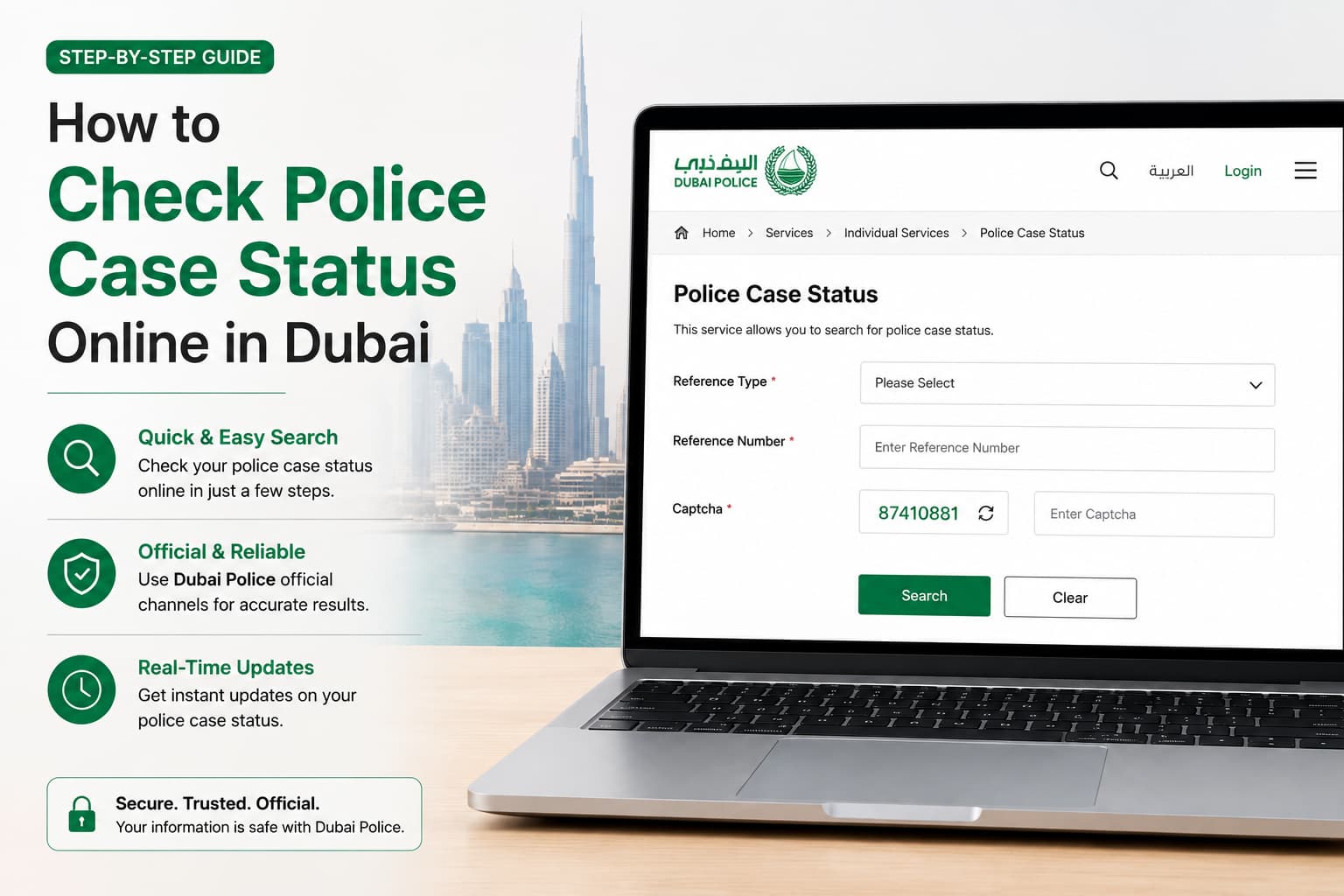
Dubai Police offers one of the most complete self-service systems in the UAE for checking a police case, whether it relates to a bounced cheque, a financial complaint, or a general criminal report. You can check your status either through the Dubai Police website or the Dubai Police Smart App, available on the App Store and Google Play.
Step-by-Step: Checking Your Case on the Dubai Police Website or App
- Visit the Dubai Police website (eservices.dubaipolice.gov.ae) or open the Dubai Police app on your phone.
- Select the relevant service — commonly "Case Inquiry," "Bounced Cheque Status," or "Circulars and Travel Bans," depending on what you're checking.
- Enter your Emirates ID (UID) number in the required field.
- Verify your identity with a one-time password (OTP) sent to the mobile number registered against your Emirates ID.
- Once verified, the system displays any active cases, circulars, or travel restrictions linked to your Emirates ID, along with the issuing department and reference number.
If a restriction appears, the portal typically indicates which authority issued it and what step is required to resolve it — commonly settling an outstanding cheque, clearing a fine, or contacting the complainant directly.
What You'll Need Before You Start
- Your Emirates ID (UID) number.
- Access to the mobile number currently registered against your Emirates ID, to receive the OTP.
- A stable internet connection — the app version tends to be faster and more reliable than the browser portal during peak hours.
If your registered mobile number is no longer active — common for expats who have left the UAE — the OTP step cannot be completed, and you'll need to explore the alternatives covered later in this guide, including checking from abroad or authorizing a lawyer through a Power of Attorney.
How to Check Police Case Status Online in Abu Dhabi
The Abu Dhabi Judicial Department has launched a platform called Estafser, which allows Abu Dhabi residents to check for any pending legal cases or claims against them. With this service, you can confirm you're not facing legal action you're unaware of. If you're worried about a travel ban due to an outstanding loan or credit card payment, you can verify your travel eligibility by providing your Unified Number (UID) on the Estafser platform.
To use the service, you must enter your Unified Number and, as with the Dubai Police service, have access to the mobile number registered against your Emirates ID.
How to Check Police Case Status in Abu Dhabi With Estafser
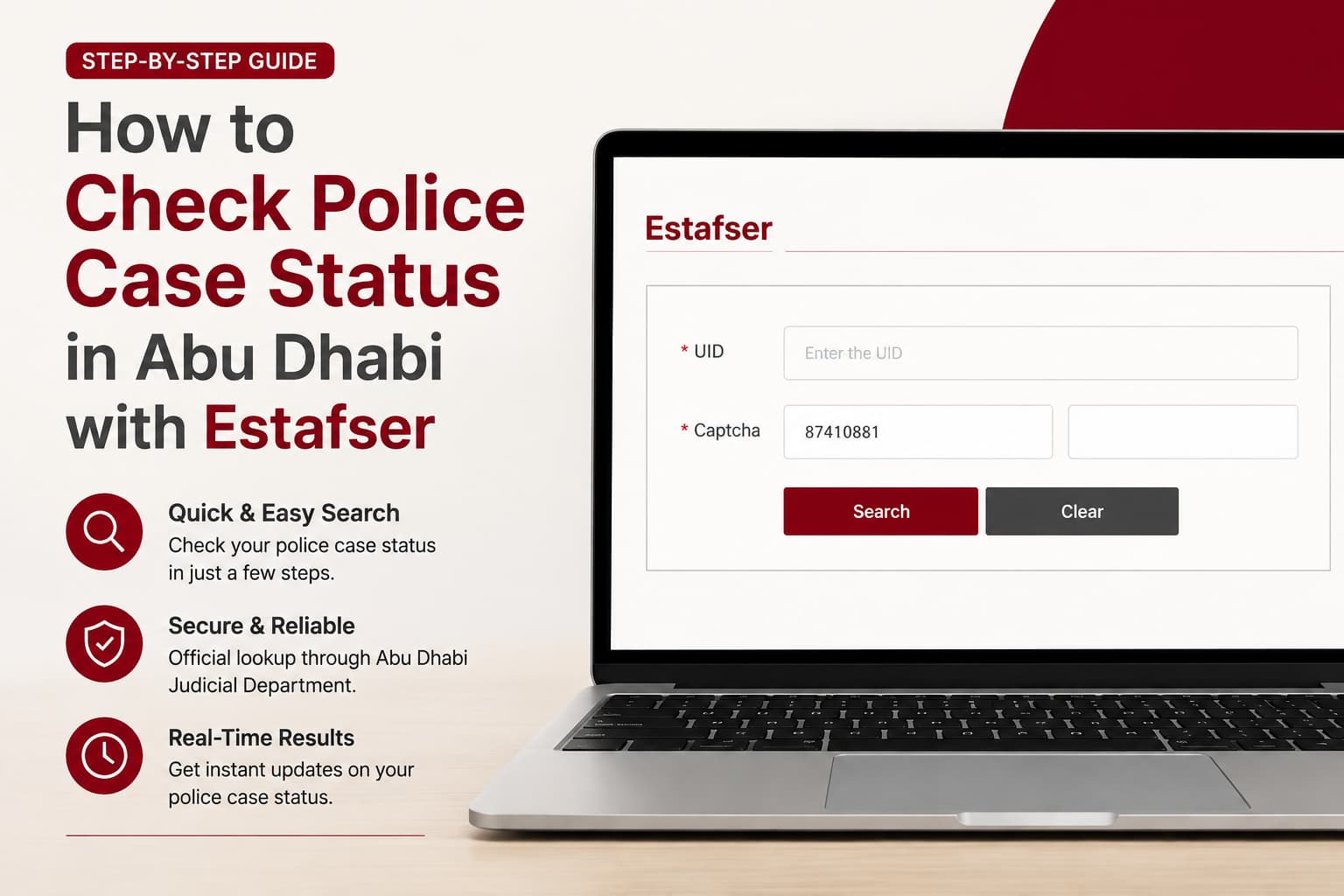
- Visit the Estafser service page.
- Enter your UID number.
- Enter the captcha.
- The Estafser service's results page will show any travel restrictions that apply to you and the reason behind them, along with what you need to do to resolve the issue.
The Estafser service offers a straightforward way for Abu Dhabi residents to check for travel restrictions before departure. A travel restriction will prevent you from exiting the country and may also affect your ability to renew your residency visa. If you're under a travel restriction, you'll need to reach out to your bank or lender to set up a payment plan. You can also check your travel ban status directly at any time to confirm whether the restriction is still active.
How to Check a Police Case in Sharjah Online
In Sharjah, checking a police case online isn't currently available, and visiting the police station in person is necessary. Here's how to proceed:
- Identify the Relevant Police Station: determine which police station in Sharjah is responsible for the area where the incident occurred or where you suspect the case might have been filed - search online or contact the Sharjah Police hotline for assistance.
- Appoint a Grantee With Power of Attorney: to prevent complications when visiting local police stations, it's advisable to appoint someone with a Power of Attorney (POA) to attend on your behalf.
- Gather Necessary Documents and Information: before visiting the police station, gather relevant documents, including your Emirates ID, passport, any incident reports, and details of the incident.
- Visit the Police Station: have your agent attend the designated police station during operating hours.
- Speak to a Police Officer: at the station, your agent can approach the CID department or financial misdemeanors section, providing the POA and a copy of the Emirates ID/passport to assist with the search.
- Request Case Information: referencing the ID particulars on the POA, the police will search records and provide your agent with available information about the case, including case numbers, dates, and incident details.
- Be Patient and Cooperative: checking a police case can take time - remaining patient and cooperative helps facilitate a smooth interaction with the police.
How to Check for a Police Case in Ajman Online
To check a police case in Ajman online, you'll need the case number, which should be available via SMS on your registered mobile number. Once you have it, follow these steps:
- Access the Link: visit the Ajman Police website's case status page.
- Input Case Information: enter your case number on the webpage.
- Enter Required Details: fill out the required fields with accurate information related to the police case you're inquiring about.
- Submit the Inquiry: once you've entered all the required information, submit your inquiry to proceed.
- Review the Results: the system will process the information and return the status of your search, such as whether the case is open, closed, or pending further action.
- Follow Up as Necessary: depending on the results, you may need to contact Ajman Police directly for further guidance.
How to Check for a Police Case in Ras Al Khaimah Online
If you're seeking a summary of a criminal case in Ras Al Khaimah (RAK), the process can be done efficiently online. Here's a simple guide:
Step 1: Access the Service. Begin by visiting RAK.ae, the official website of Ras Al Khaimah. Log in if registered, or click "Start Service" if not.
Step 2: Provide Information and Documents. Fill in all required fields with accurate information and attach supporting documents, such as your Emirates ID.
Step 3: Pay Fees Online. After completing the form and attaching the required documents, pay the necessary fees online using the available payment methods.
Step 4: Collect Requested Documents. Upon successful payment, you can collect the requested documents electronically. In some cases, you may need to visit the department in person.
Required Documents:
- For cases involving parties directly: your ID card along with proof of implementation.
- If acting as an agent: the agency document, your ID card, and proof of implementation.
How to Check for a Police Case in Fujairah, Umm Al Quwain, and Other Emirates Without Online Portals
Since an online system doesn't exist for the remaining Emirates, the most feasible option is to appoint a lawyer or grant a near relative or friend power of attorney. If you're in the UAE, the police will generally insist you attend in person. If you're out of the country, the POA will need to be attested by the department of state, the UAE embassy in your home country, and the Arabic translation attested by the Ministry of Foreign Affairs in the UAE.
The grantee appointed through the POA should visit the cheque bounce division of local police stations, or a duty officer at the CID department, with the original POA, a copy of their own ID, and a copy of the grantor's ID or passport, to look up further details. If a labour ban is part of what's affecting your ability to travel, that status can also be checked online through our Labour Ban Check guide.
How to Do a Case Inquiry by Case Number in UAE
If you already have a case number — from a court summons, a legal notice, a police report copy, or correspondence from a lawyer — it is the single most reliable way to retrieve accurate, up-to-date case information from official portals. Unlike searching by name (which can return multiple results due to transliteration variations) or by Emirates ID (which requires OTP authentication via a registered mobile number), a case inquiry by case number is direct, requires minimal authentication, and works across civil, criminal, labour, and personal status categories.
If you received a court summons, a legal notice, a police report copy, or correspondence from a lawyer, your case number will be printed on that document. Keep it safe — it is the key to tracking everything that follows.
Understanding UAE Case Number Formats
Before running a case inquiry by case number, it helps to understand the format used by different courts and portals.
Dubai Courts Case Number Format
Dubai Courts use a numeric sequence combined with the year and a case type indicator:
- Civil cases: e.g., 2045/2025/Civil or simply 2045/2025
- Criminal cases: e.g., CRIM-1120/2025
- Labour cases: e.g., LAB-889/2025
- Execution/Enforcement cases: e.g., EXE-334/2025
Some cases use prefixes like CIV for civil or CRIM for criminal. Even a single incorrect digit can return no results — always double-check the number before assuming a case does not exist.
ADJD (Abu Dhabi) Case Number Format
The Abu Dhabi Judicial Department uses a similar year-based structure but organises cases by case type and organisational unit (the specific prosecution or court circuit). When running a criminal case inquiry by case number on the ADJD portal, you will need:
- Case number
- Case year
- Case type (Administrative, Penal, Accidental)
- Organisational unit (e.g., Abu Dhabi Major Prosecution, Al Ain Traffic Prosecution, Money Prosecution)
Dubai Public Prosecution Case Number Format
The DXBPP distinguishes between two types of reference:
Criminal case number — assigned once the Public Prosecution formally accepts the file
- Police report number — the earlier reference assigned at the police station level
Both are valid inputs on the DXBPP portal, so if you only have the police number from your initial report, you can still run a case inquiry by case number there.
Case Inquiry by Case Number: Dubai Courts
The Dubai Courts portal at dc.gov.ae offers a dedicated "Inquiry by Case Number" service — no login required for basic public inquiries.
Step-by-Step
- Go to www.dc.gov.ae
- Click "Public Services" in the top navigation
- Select "Inquiry by Case Number" from the dropdown
- Choose your case category: Civil, Criminal, Personal Status, or Execution
- Enter your case number and case year
- Click "Search"
The system instantly returns:
- Current case stage (e.g., Hearing Scheduled, Judgment Issued, Adjourned)
- Next hearing date and courtroom
- Assigned judge or circuit
- Outstanding court fees or deposits
- Any active execution or enforcement orders
For verdict inquiries, Dubai Courts also offers a separate "Verdict Inquiry by Case Number" service at the same portal — useful when you want to retrieve the text or summary of a judgment that has already been issued.
All of the above is also available through the Dubai Courts Smart App (iOS and Android). The app supports push notifications, meaning you will receive an alert the moment your case status changes — a significant advantage over manual portal checks.
Case Inquiry by Case Number: ADJD Portal (Abu Dhabi)
For cases filed in Abu Dhabi, the Abu Dhabi Judicial Department (ADJD) at adjd.gov.ae is the correct platform.
Step-by-Step: ADJD Case Study Inquiry
Navigate to www.adjd.gov.ae → eServices → Case Inquiry
Select "Case Study Inquiry" for criminal matters or "Case Inquiry by Case Number" for civil
Enter the case number, case year, case type, and organisational unit
- Log in with your UAE Pass account (required for detailed results)
- Review case progress, current stage, and scheduled hearings
With ADJD, you simply enter your case number or year and the system displays the case progress, current stage, and scheduled hearings. The ADJD Smart App mirrors this functionality and adds real-time notifications for case events.
If you have filed a procedural application within an existing case (e.g., a request for adjournment, a settlement application, or a document submission), the Case Application Inquiry service tracks the status of that specific application using the same case number.
Case Inquiry by Case Number: Dubai Public Prosecution
Criminal cases that have moved past the police investigation stage and been referred to the prosecution are tracked at dxbpp.gov.ae.
Step-by-Step: DXBPP Criminal Case Inquiry
Go to www.dxbpp.gov.ae
Navigate to eServices → Case Inquiry
Choose either "Inquiry by Criminal Case Number" or "Inquiry by Police Number"
Enter the relevant reference number and click "Search"
The portal returns detailed case data, including the type of case and upcoming hearings. This is particularly useful for bounced cheque cases, fraud matters, and financial criminal complaints — categories where the case often moves between police, prosecution, and court in rapid succession.
If you are uncertain whether your matter sits with the police or prosecution, check both portals. Recent changes to UAE cheque bounce law have altered the thresholds at which financial cases become criminal, so it is worth verifying the current status on both platforms.
Case Inquiry by Case Number: MOI Portal
For matters that span multiple emirates or involve federal-level criminal proceedings, the Ministry of Interior (MOI) portal at moi.gov.ae provides a broader cross-emirate lookup.
When to Use MOI Instead of Emirate-Specific Portals
Your case was filed in a Northern Emirate (Ras Al Khaimah, Fujairah, Ajman, Umm Al Quwain)
The matter involves federal laws (immigration offences, drug-related charges, cybercrimes)
You are not certain which emirate's system holds the case
On the MOI portal, navigate to Services → Police General Services → Police Case Check and enter either your Emirates ID, passport number, or case reference to retrieve status information.
Case Inquiry by Case Number: DIFC Courts
The DIFC Courts eRegistry at difccourts.ae allows case number searches and publishes all judgments and orders. DIFC case numbers follow the format CFI-XXX/YYYY (Court of First Instance) or CA-XXX/YYYY (Court of Appeal).
What to Do If Your Case Number Returns No Results
A "case not found" result does not always mean there is no active case. Here are the most common causes and fixes:
Wrong format or missing prefix — Re-enter the number with the correct category prefix (CIV, CRIM, LAB). Some portals require the year to be entered in a separate field; others want it as part of the number string.
Wrong portal for the emirate — A Dubai case will not appear on the ADJD portal and vice versa. Confirm which emirate's court system has jurisdiction before running your search.
- Case not yet digitised — Older cases (pre-2010) may not appear in online systems. Visit the relevant court's Customer Happiness Centre in person with your Emirates ID and any case documents.
Case under a different party name — If you are a secondary party or a witness rather than the primary defendant or claimant, the case may be indexed under the primary party. Try a name-based or Emirates ID-based search as an alternative.
Processing delay — Newly filed cases typically appear in the online system within 1–3 working days of registration. If you filed or were served very recently, wait and try again.
For situations where the case number simply cannot be located through official portals — particularly for individuals outside the UAE — Wirestork's court and police case checking service conducts manual verification across all emirates and delivers a consolidated report within five business days, no Power of Attorney required.
Case Inquiries and Travel Bans
One of the most important reasons to run a case inquiry by case number is to determine whether the case has generated a linked travel ban. Courts and prosecutors can impose travel restrictions in financial cases, criminal investigations, and large civil disputes — and the ban often exists before the affected person is even aware of the underlying case.
Since 2024, the UAE Ministry of Justice confirmed that travel bans linked to resolved cases are lifted automatically the moment the legal matter is settled — no additional paperwork required. But resolution requires awareness first. If a ban hasn't lifted automatically, or was issued in error, our guide on Travel Ban Appeal walks through the appeal process.
If your case inquiry reveals an active enforcement order or linked restriction, our guide on how to check travel ban in UAE covers every method available, from official portals to professional verification.
How to Check a UAE Prosecution Case Status From Abroad
Most people discover the hard way that the UAE's official portals were built with a resident — physically present, still holding an active SIM card — in mind. Once you've left the country, that assumption starts working against you. This is a genuinely common situation: someone completes an exit, cancels their residence visa, and only later learns — often from a worried family member, a former employer, or a bank notice — that a complaint may have been filed against them.
Why Checking From Abroad Is Different From Checking Locally
UAE case-inquiry portals were designed around residents actively living in the country, which creates specific friction once you're checking from outside its borders.
The Core Obstacle: Identity Verification
Nearly every official portal — Dubai Police, Estafser, the MOI e-Services platform — relies on either an Emirates ID number paired with an OTP sent to a UAE-registered mobile number, or a UAE Pass login tied to the same mobile number. If your UAE SIM was cancelled when you left, or your Emirates ID has since expired, that verification step simply won't complete, regardless of how accurate your other details are.
Official Portals You Can Still Access From Outside the UAE
Before assuming you need a lawyer, it's worth confirming whether you can still complete the identity verification step yourself.
Abu Dhabi's Estafser Service: Estafser, run by the Abu Dhabi Judicial Department, checks whether the Public Prosecution has any claim or request against you within Abu Dhabi. It's accessible from anywhere online, but requires your Unified Number and, in most cases, a working UAE Pass login or registered mobile number for verification — so it works from abroad only if that access is still intact.
Dubai Police "Circulars and Travel Bans" Service: This Dubai Police service checks for financial case-related circulars and travel bans tied to your Emirates ID. Like Estafser, it's technically reachable from any country, but the OTP verification step is the practical barrier if your UAE number is no longer active.
Dubai Public Prosecution Case Inquiry: If you already have a specific case number or police report number — for instance, from a notice you received before leaving — the Dubai Public Prosecution portal allows inquiry directly by that reference, which can bypass some of the broader identity verification friction since you're pulling a known file rather than searching by identity.
UAE Ministry of Interior e-Services (Federal Level): The MOI's e-Services platform offers a federal-level "Police Cases Inquiry" that can be useful if you're unsure which emirate a case might be registered in, though it carries the same Emirates ID and verification requirements as the emirate-specific portals.
When Self-Service Portals Won't Work for You
If you've tried the official channels and hit a wall, it's almost always one of two specific issues.
No Active UAE Mobile Number for OTP: This is the single most common blocker. Without a live UAE SIM registered to your Emirates ID, you cannot receive the OTP codes these systems require, and there is currently no standard workaround for receiving that code on a foreign number.
Expired or Inaccessible Emirates ID: If your Emirates ID has expired since you left the UAE, or you no longer have the physical card and its number, several portals will not process your inquiry at all, since the ID number itself is often the primary key the system searches against.
The Power of Attorney Route for Overseas Case Checks
When self-service isn't possible, authorizing a UAE-licensed lawyer to check on your behalf through a Power of Attorney (POA) is the standard and most reliable path. Our Lawyer on Call service can connect you with a UAE-licensed lawyer to handle this remotely, from drafting the POA to requesting the case status directly.
- Step 1 — Draft the POA With a UAE-Licensed Lawyer: Have a UAE lawyer draft a POA specifically authorizing them to inquire about, obtain extracts of, and represent you in relation to any prosecution or court matter under your name. Being specific about the scope avoids delays later when the document is presented to the prosecution office.
- Step 2 — Legalise It Through the UAE Embassy or Consulate: Since you're signing from outside the UAE, the POA typically needs to be executed before a notary in your country of residence and then legalised through the UAE Embassy or Consulate there — or, where your country participates in the Apostille Convention alongside the UAE, through an apostille that streamlines this step.
- Step 3 — Attest It in the UAE (MOFA): Once the document reaches the UAE, it generally requires attestation by the UAE Ministry of Foreign Affairs (MOFA) before it can be relied upon by a court, prosecution office, or notary inside the country.
- Step 4 — Your Lawyer Requests the Case Status Directly: With the attested POA in hand, your lawyer can approach the relevant Public Prosecution office or court directly, request official confirmation of your case status, and, where relevant, review the case file, assess bail or defence options, and represent you going forward without your physical presence in the UAE.
What a UAE Lawyer Can Access That Online Portals Cannot
Portals return a status snapshot, but they don't explain what that status means for you, whether multiple reference numbers on file relate to the same underlying matter, or what your realistic options are. A lawyer working from your POA can request official written extracts, follow up directly with the investigating authority, and clarify whether a case has moved between the police stage, the Public Prosecution, and the courts — something the self-service systems often don't make clear on their own.
Understanding What "Prosecution Stage" Actually Means
If your check does return a result, knowing what it means matters:
"Under investigation" means the police are still reviewing the complaint and no prosecution decision has been made.
"Referred to Public Prosecution" means the police stage has concluded and the prosecutor is now deciding whether to escalate to formal charges.
"Referred to court" means charges have been filed and a hearing process is underway — at this stage, a travel ban is typically active if you were to attempt re-entry.
Each of these carries different implications for how urgently you need legal representation.
What to Do If You Find an Active Prosecution Case From Abroad
If your check — whether self-service or through your lawyer — confirms an active case, don't attempt to resolve it informally or ignore it hoping it lapses. Note every reference number and issuing authority exactly as provided, and engage a UAE-licensed lawyer promptly, particularly for financial cases, many of which can be resolved directly with the complainant even from abroad. Avoid returning to the UAE without first understanding whether a travel ban or arrest risk exists, since re-entry with an unresolved case can result in detention at the airport with no advance warning.
How to Check the Criminal Status of Financial Cases in the UAE
The steps for checking the criminal status of a financial case follow the same portals already covered above — the Dubai Police service for Dubai-filed matters, Estafser for Abu Dhabi, and the MOI e-Services platform at moi.gov.ae for a federal-level lookup if you're unsure which emirate a case sits in. In each case, you'll need your Emirates ID or Unified Number, plus access to your registered mobile number for OTP verification. If the check flags an active case, the result will indicate what's required to resolve it — for complex matters, it's worth consulting a legal specialist rather than relying solely on the portal's summary.
Comprehensive Options to Check a Police Case in the UAE Online
Between the emirate-specific portals, the case-number lookups, and the abroad-checking routes covered above, you now have every legitimate way to check a police case in the UAE online. If your search turns up a travel restriction rather than a resolved matter, run a UAE travel ban check next to confirm the scope of the restriction before you make any travel plans.
Frequently Asked Questions
What is a travel ban in the UAE?
Travel bans in the UAE, also known as immigration bans, refer to persona non grata status - a security measure that prohibits a person from entering or residing in the UAE. Immigration bans or travel bans are regulated by the Immigration and Naturalization Department and the Ministry of Interior. In principle, immigration bans are activated against a person either when they have committed a crime or when an employer has requested such action after incurring serious damage. An immigration ban prevents the person from entering or staying in the country and is typically followed by an order to leave immediately. The term is generally one year, but may be as short as six months or even for life.
Can I Be Arrested at the Airport in the UAE for an Unpaid Debt?
Potentially, yes. If a signatory doesn't respond to a police complaint or cannot be located, authorities can circulate a travel ban request to immigration. If that person then attempts to travel, immigration authorities can detain them at the airport. This is one of the main reasons it's worth running a case or travel ban check before booking a flight if you have any reason to believe a complaint may have been filed against you.
How Can I Check My Immigration Status in the UAE?
If it's been more than six months since your last exit from the UAE, your visa should generally be canceled by your employer. If you fled the country, it's likely you were reported as absconding to MOHRE by your employer. Your entry permit/residence visa validity, if issued from Abu Dhabi, Sharjah, Ajman, Umm Al Quwain, Ras Al Khaimah, or Fujairah, can be checked via the Federal Authority for Identity and Citizenship website. Entry permits and residence visas in Dubai can be validated through the Amer-GDRFA service - if a restriction turns up, you can pursue a Travel Ban Appeal depending on the circumstances.
Can an Immigration Ban Be Lifted in the UAE?
Travel bans/immigration bans may be removed on a case-by-case basis with prior approval from GDRFA. Applications for such removal should be made directly to the respective Emirate's naturalization and residency department, and approval may be obtained if: 1. the applicant can provide a valid excuse; 2. the applicant's dependents reside in the UAE at the time of application; or 3. the applicant has significant business investments in the UAE.
Decisions on this subject are regulated by a humanitarian committee and generally cannot be appealed.
What Happens if You Have a Police Case in Dubai?
If you have a police case in Dubai, the process depends on the nature of the case and UAE law. Generally, if accused of a crime, you'll be taken into police custody and questioned. You may also need to provide evidence, attend court appearances, and possibly face trial. If convicted, the punishment depends on the specific crime and severity, ranging from fines and community service to imprisonment or deportation. UAE law can be quite different from that in other countries, even for seemingly minor offenses. If you find yourself in this situation, it's recommended you contact a local lawyer for legal assistance and guidance on the steps you should take.
How Can I Clear My Police Case in the UAE?
Here are the general steps to clear a police case in the UAE:
- Start with a court and police case check to obtain detailed case filings and identify the current status of proceedings and judgments.
- Obtain legal representation to assist with your case.
- Negotiate with prosecutors, with your legal representative, to find a resolution.
- Attend all necessary court hearings to present your case and receive a verdict.
- Follow any court orders or penalties issued, to ensure the case is cleared.
- Obtain a clearance certificate from the local police station once the case is resolved, to prove you have no pending cases.
Note: the process of clearing a police case can vary depending on the type of case and severity of the crime. It's recommended to consult a local legal professional for specific guidance.
What Is a Penal Case in the UAE?
A penal case in the UAE refers to a criminal case or lawsuit where an individual or organization is charged with a criminal offense such as theft, fraud, embezzlement, assault, or another offense specified under the UAE Penal Code. If found guilty, the accused may face imprisonment, fines, or other penalties. Penal case proceedings are handled by UAE courts, governed by the Federal Penal Code and the relevant regulations of each Emirate.
Can I Leave the UAE if I Have a Court Case?
Yes, and no. In some cases, the court may grant permission to travel while the case is ongoing; in others, it may require the defendant to remain in the country until resolution. If facing a criminal case, the court may also impose travel restrictions or confiscate your passport. It's best to seek advice from a lawyer to determine whether you can leave the UAE with a pending court case.
Does a Civil Case Affect Visa Applications in the UAE?
If you have a pending civil case, you may not be able to renew or obtain a new visa until the case is resolved, since authorities may view you as a potential liability or risk. The outcome of the case can also impact your visa status - if found liable, you may face visa restrictions or denial. It's important to consult a lawyer or immigration expert for guidance on your specific situation.
What Crimes Can Result in Imprisonment in the UAE?
The following can lead to jail time in the UAE:
- Drug abuse or trafficking — the UAE has strict laws against drug use and trafficking, with penalties that can include life imprisonment.
- Fraud and financial crimes — including embezzlement, counterfeiting, and money laundering, with penalties ranging from fines to imprisonment.
- Theft and robbery — a serious crime in the UAE, with penalties including imprisonment and fines.
- Drunk driving — driving under the influence is prohibited, with penalties including imprisonment, fines, and license suspension.
- Cybercrime — including hacking and online fraud, with penalties including imprisonment, fines, and asset seizure.
- Harassment and assault — including physical or sexual assault and stalking, with penalties including imprisonment and fines.
- Defamation and libel — spreading false information about someone or a company, with penalties including imprisonment, fines, and compensation to affected parties.
Note: UAE laws and regulations change regularly, and this list may not be exhaustive. It's always recommended to consult a legal professional for specific questions.
Can I do a case inquiry by case number in UAE for free?
Yes. All official portals — Dubai Courts, ADJD, DXBPP, and MOI — offer case number inquiries free of charge. No fees apply for basic status lookups; charges only arise for certified documents or new filings.
What if I only have a police report number, not a court case number?
Use the Dubai Public Prosecution portal (dxbpp.gov.ae) and select "Inquiry by Police Number." The DXBPP system accepts the police report number as a valid input and maps it to the corresponding prosecution file.
How do I find my case number if I lost it?
If you were served with court papers, the number appears on the summons or claim form. If you filed the case yourself, check your original filing receipt. Alternatively, you can search by your name or Emirates ID on the Dubai Courts portal to retrieve the associated case numbers.
Does a case inquiry by case number show hearing dates?
Yes. Successful queries on Dubai Courts, ADJD, and DXBPP all return upcoming hearing dates alongside case stage, assigned circuit, and outstanding fees.
Can I track a DIFC court case by case number?
Yes. The DIFC Courts eRegistry at difccourts.ae allows case number searches and publishes all judgments and orders. DIFC case numbers follow the format CFI-XXX/YYYY (Court of First Instance) or CA-XXX/YYYY (Court of Appeal).
What does "Adjourned" mean in a UAE case inquiry?
"Adjourned" means the scheduled hearing was postponed and a new date has been set. The portal will display the next hearing date. Adjournments are common and do not indicate a problem with your case — but missing the rescheduled hearing can have serious consequences. Missing the rescheduled hearing can lead to a default judgment against you.
Can businesses track cases against debtors using a case number?
Yes. Businesses pursuing Debt Collection frequently use case inquiry by case number to monitor execution proceedings against debtors. The Dubai Courts execution section updates enforcement status in real time, including whether assets have been seized or accounts frozen.
Can I check a UAE prosecution case status from abroad without a lawyer?
Yes, if you still have an active UAE-registered mobile number and a valid Emirates ID or Unified Number, portals like Estafser, Dubai Police, and the MOI e-Services platform remain accessible from outside the UAE for identity-based checks.
What if my UAE mobile number is no longer active?
Without a working UAE SIM for OTP verification, most self-service portals cannot complete your inquiry. The standard alternative is authorizing a UAE-licensed lawyer through a Power of Attorney to check the case status directly with the relevant authority.
How do I get a Power of Attorney legalised to check a UAE case from abroad?
The POA is typically signed before a notary in your country of residence, legalised through the UAE Embassy or Consulate there (or via apostille where applicable), and then attested by the UAE Ministry of Foreign Affairs once it reaches the UAE.
Can I check a UAE prosecution case status from abroad using just my passport number?
Passport number checks are more limited than Emirates ID-based inquiries and are not universally supported across all portals. A specific case number, if you have one, is usually a more reliable identifier for a direct inquiry.
Is it safe to return to the UAE if I'm unsure about a prosecution case?
No. If there's any uncertainty about an active case or travel ban, confirm your status first, either through an accessible portal or a lawyer, before attempting to re-enter the UAE, since an unresolved case can result in detention at the airport.
Related Guides
- AML Froze Your UAE Bank Account? Here's the Fast Way Out
- Overstay Fines Stacking on Your Entry Permit? Fix It Fast
- Bounced Cheque Fee for a Signature Glitch? Fight It
- Bought Your Rental? Here's How to Get Your Deposit Back
References
- Dubai Courts — Inquiry by Case Number. Government of Dubai. dc.gov.ae
- Abu Dhabi Judicial Department — Case Study Inquiry / Estafser. Government of Abu Dhabi. adjd.gov.ae
- Dubai Public Prosecution — eServices. Government of Dubai. dxbpp.gov.ae
- Ministry of Interior — Police Case Check / e-Services: File Criminal Reports. Federal Government of UAE. moi.gov.ae
- Ajman Digital Department — Case Status Inquiries. Government of Ajman. ajman.ae
- The Official Portal of the UAE Government — Criminal Cases: Litigation Procedures
- Dubai Courts — Case Inquiry by Categories
Disclaimer: This article is for general informational purposes only and does not constitute legal advice. Portal procedures, requirements, and processing times can change without notice and may vary by emirate. Always verify current requirements through the official portal in question, or consult a UAE-licensed lawyer regarding your specific circumstances, particularly if a case inquiry reveals an active complaint, prosecution referral, or travel ban.
Check Your UAE Court & Police Record with Confidence
Our lawyer-backed verification service helps identify police complaints and court cases across the UAE through trusted local legal professionals. Fast, confidential, and designed to give you peace of mind before you travel.
Check NowGeorge Mathew writes on corporate governance, business setup, and commercial contracts in the UAE. He covers mainland and free zone company formation, shareholder agreements, and the practical implications of the Companies Law for SMEs and multinational branches operating in the UAE.
Share this article
Stay informed.
Receive important legal and regulatory updates across the UAE, Saudi Arabia and the wider GCC.
No spam. Unsubscribe anytime.
Continue Reading
More Legal Insights
UAE Unlimited Contract Abolished: What It Means for Employers and Employees in 2026
UAE unlimited employment contracts were abolished by Federal Decree-Law No. 33 of 2021, ef…
Saudi Work Permit Cancelled After 3 Months' Absence (2026 Qiwa Rule)
From June 30, 2026, Saudi Arabia automatically cancels Qiwa registration for non-Saudi wor…
Qiwa Contract Limit 2026 & Saudi Work Visa Quotas: Nitaqat Overhaul Explained
The Qiwa platform caps Saudi nationals at seven employment contracts per year and two simu…