How the Underlying Process Works
Criminal cases in the UAE follow a structured, three-tier process under Federal Decree-Law No. 38 of 2022 (the Criminal Procedures Law), which replaced the country's older criminal procedure framework and consolidated how complaints move from a police station to a courtroom. A complaint is first registered with the police, who investigate and typically refer the file to the Public Prosecution within 48 hours. Under Article 9 of the law, only the Public Prosecution has the authority to file formal charges and refer a matter to trial - the police cannot do this themselves, no matter how serious the underlying allegation. This three-stage structure is precisely why the same case can show different information depending on which portal you check: the Dubai Police system reflects the investigative stage, while the Dubai Public Prosecution portal only lights up once a file has actually crossed into the second stage.
Why the Status Label Matters More Than It Appears
It is tempting to treat a case-status check as a formality - a box to tick before booking a flight. In practice, each label carries distinct legal consequences, and confusing them is one of the more common and costly mistakes people make when trying to interpret their own results.
- Under Investigation: police are still gathering evidence and statements; you may be called in for questioning, and a travel restriction is possible but not guaranteed at this stage.
- Referred to Public Prosecution: the police file has moved to the prosecutor, who will independently review the evidence and decide whether to press formal charges, dismiss the matter, or request further investigation.
- Referred to Court: formal charges have been filed and a trial is underway - a travel ban is commonly active at this stage, and legal representation becomes considerably more important.
- Closed: the matter has concluded, whether through dismissal, an out-of-court settlement, or a final judgment - though 'closed' online does not always mean every downstream consequence, such as a travel ban, has been automatically lifted.
How to Check via Dubai Police
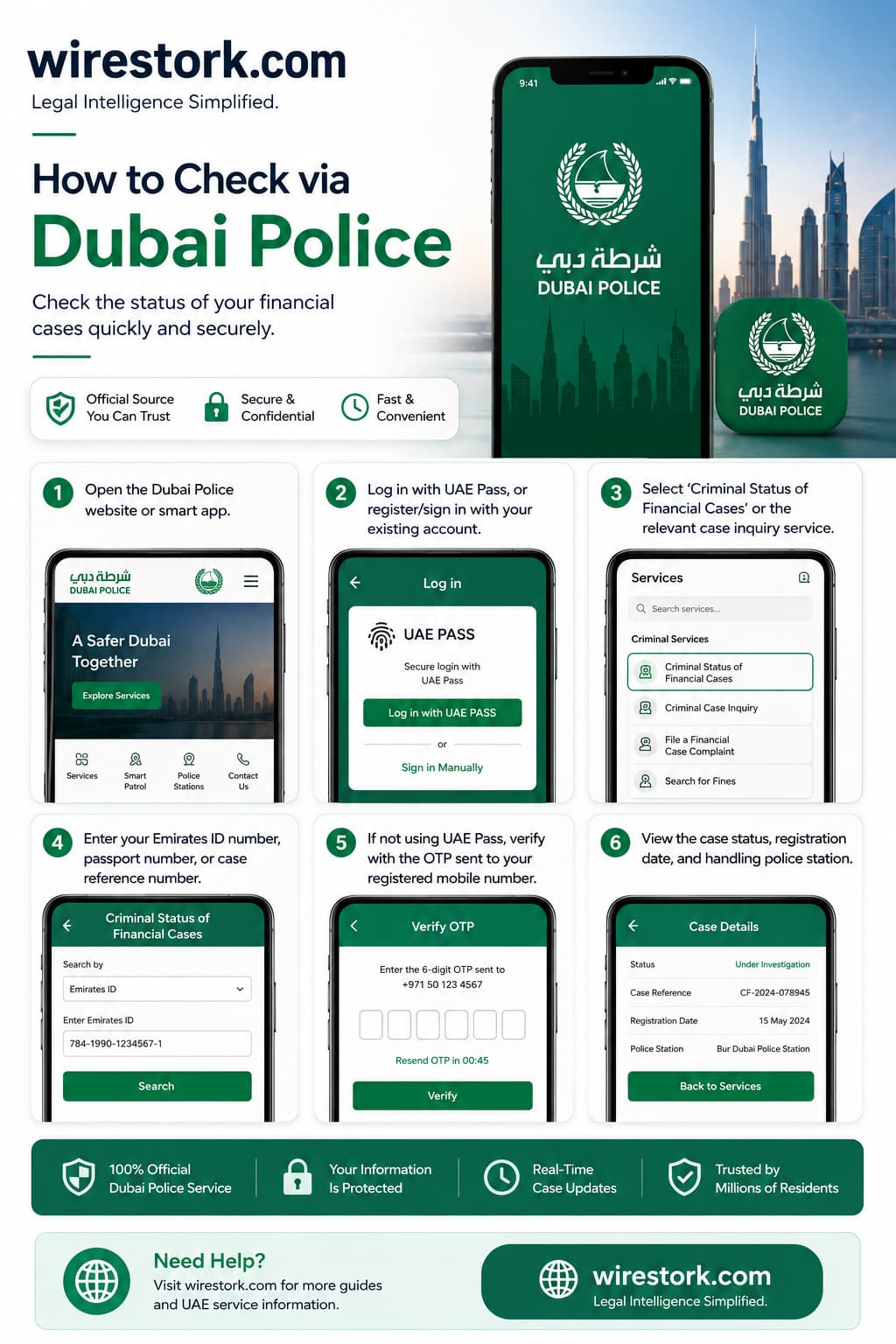
- Open the Dubai Police website or smart app.
- Log in with UAE Pass, or register/sign in with your existing account.
- Select 'Criminal Status of Financial Cases' or the relevant case inquiry service.
- Enter your Emirates ID number, passport number, or case reference number.
- If not using UAE Pass, verify with the OTP sent to your registered mobile number, then view the case status, registration date, and handling police station.
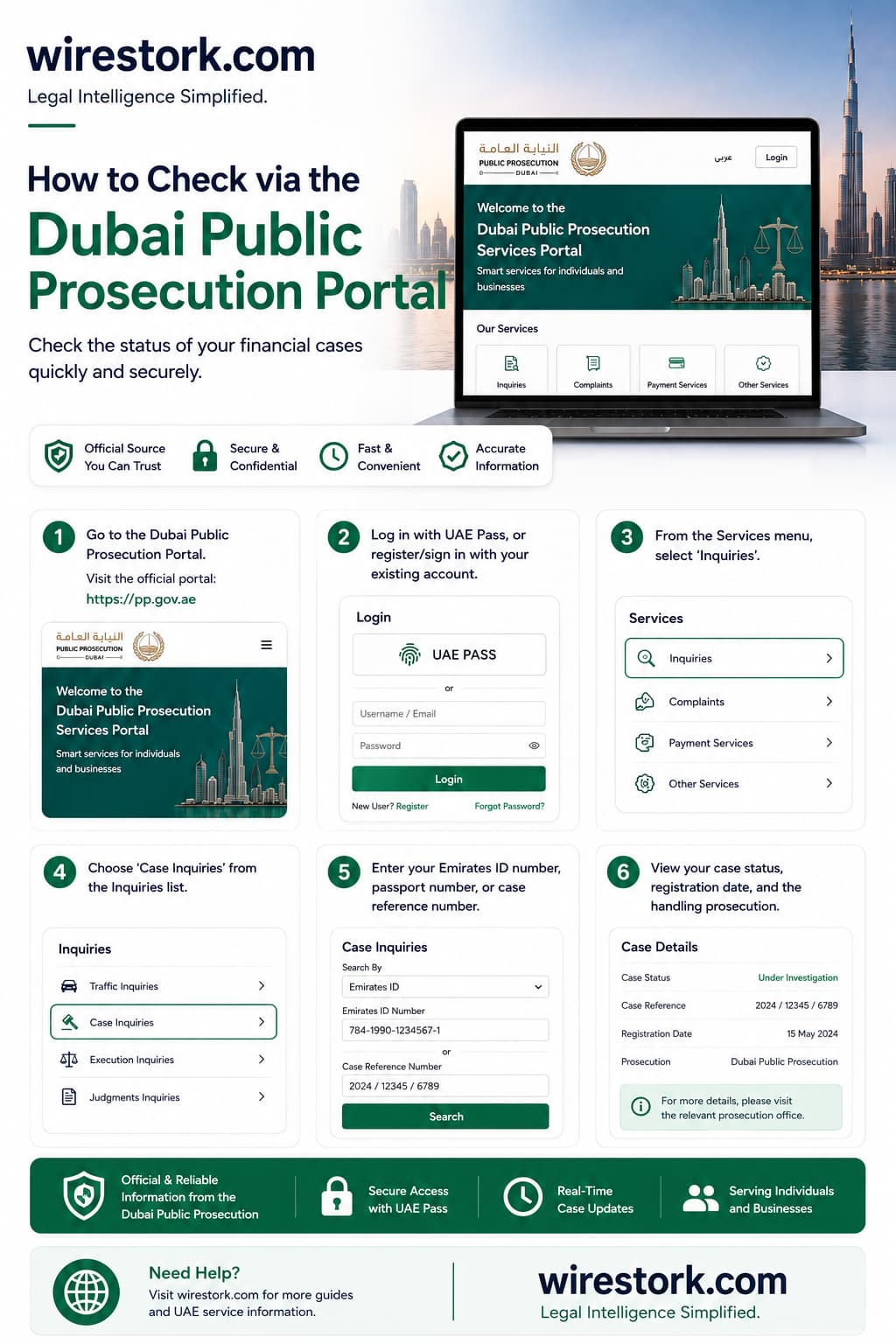
How to Check via the Dubai Public Prosecution Portal
Once a matter has moved to the prosecution stage, the Dubai Public Prosecution (DXBPP) portal offers considerably more detail than the Dubai Police portal. It allows a search by criminal case number or police report number and returns the specific charges and prosecutorial decisions on file, rather than a bare status label. This distinction matters in practice: a lawyer reviewing a case for a client will typically start at Dubai Police to confirm a file exists, then move to DXBPP once the file has progressed, since that is where the substantive detail - the actual charge, the hearing schedule, the prosecutorial reasoning - becomes visible.
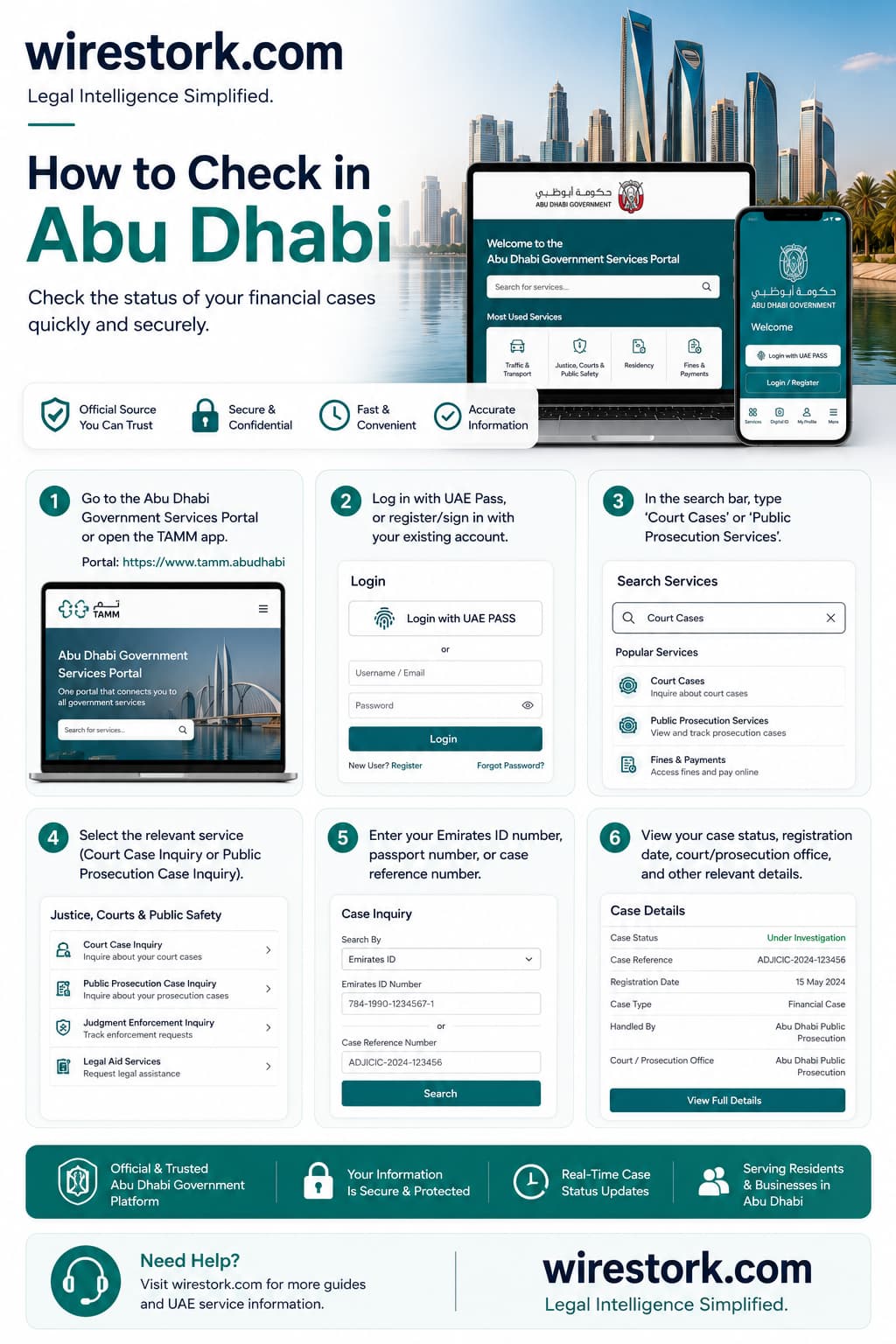
How to Check in Abu Dhabi and Other Emirates
Abu Dhabi residents can use the Abu Dhabi Judicial Department's Estafser e-service with their unified ID number to check for Public Prosecution claims. For the Northern Emirates - Sharjah, Ajman, Umm Al Quwain, Ras Al Khaimah, and Fujairah - where standalone portals are more limited, the federal Ministry of Interior's e-services portal covers police case inquiries using an Emirates ID or case number. This patchwork of systems reflects the UAE's dual judicial structure: Dubai and Abu Dhabi maintain fully independent local judiciaries with their own digital infrastructure, while the remaining Emirates fall under the Federal Judiciary and rely on centralized federal platforms.
This is a meaningful distinction for anyone assuming a single national portal exists. It does not. A case registered in Fujairah will not appear on the Dubai Police app, and a case handled by Dubai Police will not surface through the federal MOI portal - checking the wrong system is one of the most common reasons people conclude, wrongly, that they have no case at all.
Legal Representation and Language Rights at the Prosecution Stage
Once a case is referred to the Public Prosecution, the person named in it is entitled to engage a lawyer to attend any questioning session, review the evidence file to the extent permitted at that stage, and request an official interpreter if Arabic is not their first language. These rights exist regardless of whether the case was discovered through a personal check or a formal summons, and exercising them early - rather than waiting for a court date - is generally the more effective strategy, since prosecutorial decisions are easier to influence before formal charges are filed than after.
If you'd rather not navigate multiple government portals yourself, our court and police case check service has a lawyer approach the relevant MOI and court offices directly on your behalf and returns a consolidated report with step-by-step next steps if a case is found. For a broader walkthrough of every available method, see our complete guide to checking a police case in the UAE online.
Checking Offline
If a case isn't visible online, or you can't complete OTP verification, you can visit the police station where the case was reported (or contact ADJD for Abu Dhabi matters) with your Emirates ID and passport copy. This route remains available specifically because digital systems are not always synchronized in real time with paper-based station records, particularly for cases filed in the preceding 24 to 48 hours.
Common Reasons You Can't Complete the Check
- OTP mismatch: your registered mobile number must match both your Emirates ID file and your GDRFA record - a mismatch or an old number blocks verification.
- No access to that number from abroad: checking from outside the UAE still works if you can receive the OTP or log in via UAE Pass - if you can't, you'll need to update your details or seek help through a lawyer or the issuing authority.
- Newly filed cases: a case can take anywhere from a few hours to several business days to appear online after being registered.
- Name transliteration differences: a passport name spelled differently across documents (a common issue for names transliterated from Arabic, Hindi, or other scripts) can cause a genuine case to appear as 'not found' when searched manually rather than by Emirates ID number.
- A recently renewed Emirates ID: some portals take time to sync a newly issued Emirates ID number to an older case file, particularly where the case predates the renewal.
Frequently Asked Questions
What information do I need to check my case status online? Your Emirates ID number, a mobile number correctly registered to both your Emirates ID and GDRFA file (or a UAE Pass login), and ideally a police report or case number.
Can I check an Abu Dhabi case using my Emirates ID? Yes, through the Abu Dhabi Judicial Department's Estafser service using your unified ID number.
What's the difference between the Dubai Police portal and the Public Prosecution portal? Dubai Police covers police-stage cases; the DXBPP portal shows detail once a matter reaches the prosecution stage, including specific charges.
Can I check my status from outside the UAE? Yes, provided you can still receive the OTP or log in via UAE Pass.
Does a 'Closed' status mean any travel ban linked to my case is automatically lifted? Not necessarily. A closed criminal case and an active civil travel ban (for example, over unpaid debt connected to the same events) can be recorded separately, so it's worth checking your travel ban status independently rather than assuming one automatically clears the other.
Why does my case not appear when I search by name instead of Emirates ID? Transliteration differences between how your name is spelled on your passport, Emirates ID, and the original police report can cause a name-based search to miss a genuine case - searching by Emirates ID or case number is more reliable.
Key Takeaways
- Dubai Police, the DXBPP portal, Abu Dhabi's Estafser, and the federal MOI e-services portal each cover different stages or Emirates - check the right one for your situation.
- Case status labels (Under Investigation, Referred to Public Prosecution, Referred to Court, Closed) carry real practical differences, including travel ban risk.
- OTP verification depends on your mobile number matching your Emirates ID and GDRFA records exactly.
- A 'Closed' case status and an active travel ban are recorded separately and should be checked independently.
Conclusion
Checking your case status by Emirates ID takes minutes through the right official channel, but knowing which status labels mean what - and which portal to use for your Emirate and case stage - determines how useful the result actually is. The UAE's move toward unified digital identity through UAE Pass has made these checks considerably faster than they were even a few years ago, but the underlying legal structure - police, then prosecution, then court, each with its own record system - has not changed, and understanding that structure remains the difference between a genuinely informative check and a misleading one. If a case turns up, or you can't get a clear answer through official channels, speaking with a licensed UAE lawyer before your next trip abroad is the safer move.
References
- UAE Legislation Portal - Federal Decree-Law No. 38 of 2022 (Criminal Procedures Law)
- Dubai Police - Criminal Status of Financial Cases service
- Dubai Public Prosecution (DXBPP)
- Abu Dhabi Judicial Department - Estafser e-service
- UAE Ministry of Interior e-services portal