
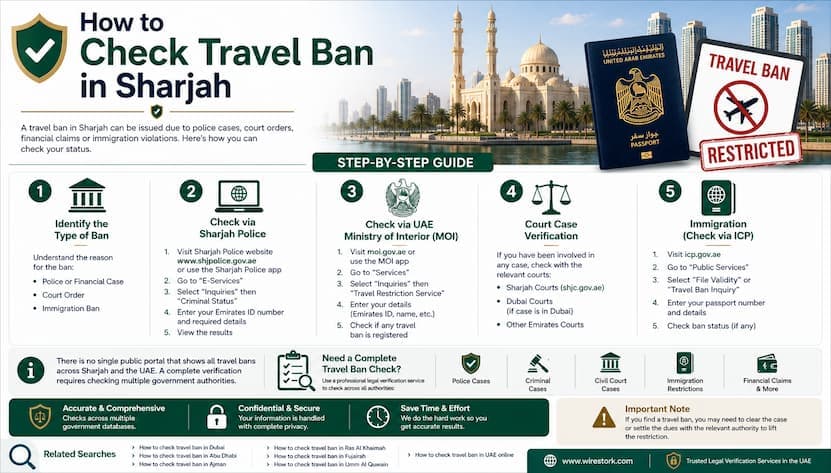
For residents of Dubai, confirming a travel ban is a matter of minutes: open an app, enter an Emirates ID, get an answer. For residents of Sharjah, it is not. The emirate has no public, self-service system for checking whether a person is barred from leaving the country, a gap that continues to catch expats and business owners off guard at the passport control desk.
That gap is not an oversight so much as a structural difference in how the Northern Emirates administer legal inquiries compared with Dubai and Abu Dhabi. This guide sets out, in practical terms, what a Sharjah travel ban is, how it differs from an immigration ban, the verification channels actually available to residents, and what the recovery process looks like once a case is closed. Where relevant, it draws on guidance published by Dubai Police, the Abu Dhabi Judicial Department, Sharjah Police, and the UAE's federal government portal.
This guide explains how UAE residents can check for a travel ban in Sharjah, an emirate that — unlike Dubai or Abu Dhabi — has no public online self-check portal. It covers the four practical verification methods (visiting a Sharjah Police station/CID, using the Sharjah Public Prosecution app, engaging a licensed UAE lawyer for passport-based checks, and consulting the federal u.ae government portal), the documents required, common causes of bans (debt, civil/commercial cases, criminal investigations, labor and family disputes), the process for lifting a ban once resolved, and why any ban — regardless of which emirate issued it — applies at every UAE airport due to the federal nature of travel restrictions.
Generated by AI · Not legal advice
- Sharjah has no public online portal for a personal travel ban self-check.
- The two most reliable in-person routes are a Sharjah Police station/CID visit or the Sharjah Public Prosecution app.
- Passport-number checks in Sharjah typically require a licensed UAE lawyer, unlike Dubai's self-service option.
- Travel bans are federal — a Sharjah-issued ban blocks travel from any UAE airport.
- Common causes: unpaid debts, bounced cheques, civil/commercial disputes, criminal investigations, labor and family matters.
- Lifting a ban requires settling the underlying case and obtaining written clearance submitted to immigration.
What a Travel Ban Actually Is — and Why Sharjah Handles It Differently
Under UAE law, a travel ban is a restriction that prevents an individual from leaving — or in some cases entering — the country until a specific legal or financial matter is resolved, according to guidance published on the UAE's official government portal. It is a distinct instrument from an immigration ban, a point of confusion that persists even among long-term residents. A travel ban is typically case-driven: an open debt, a pending lawsuit, a criminal complaint, or a family dispute keeps it active until the case underlying it is formally closed. An immigration ban, by contrast, concerns a person's standing to enter or remain in the UAE at all, and is more often tied to a deportation order or a serious breach of residency rules.
The practical difficulty for Sharjah residents is infrastructural rather than legal. Dubai has consolidated its inquiry process through the Dubai Police portal and the Amer service; Abu Dhabi channels the same function through the Judicial Department's Estafser platform. Sharjah, along with Ajman, Fujairah, Ras Al Khaimah, and Umm Al Quwain, has not built an equivalent public-facing tool, so residents are directed instead to police stations or the Ministry of Interior's channels — a system that predates the app-based checks now standard in Dubai and Abu Dhabi.
This distinction explains why a generic search for "UAE travel ban check" so often misleads Sharjah residents: the tools that dominate the search results were built for a different emirate's administrative system.
Why a Travel Ban Gets Issued in Sharjah
Before turning to verification, it is worth understanding what typically triggers a ban. Legal practitioners consistently point to a narrow set of recurring causes:
- Unpaid debts or bounced cheques — still the most frequent trigger, often tied to personal loans or unpaid rent.
- Open civil or commercial disputes — including unresolved contracts and business litigation.
- Criminal investigations — a ban can be imposed before formal charges are filed.
- Labor disputes — complaints lodged by either an employer or an employee.
- Family or custody matters — commonly linked to alimony or child-support disputes.
One detail is frequently overlooked: resolving the underlying financial obligation does not, on its own, clear a person's record. Terminating a Sharjah tenancy agreement, for instance, does not prevent further legal proceedings even where the financial terms appear settled; a court case status check is the only way to confirm whether a filing remains open. The case must be formally closed, and that closure communicated to the relevant authority, before any associated ban lifts.
How to Check Your Travel Ban Status in Sharjah: Four Verification Routes
1. Visit a Sharjah Police Station or the CID
The most direct method remains an in-person inquiry. Sharjah, together with Ajman, Ras Al Khaimah, Fujairah, and Umm Al Quwain, requires residents to approach the originating authority: a court-related matter is handled through the public prosecution office, while a police-related complaint can be raised at Sharjah Police directly. Bring an Emirates ID and passport, and specify the Criminal Investigation Department (CID) if the matter is believed to be police-related rather than civil. A preliminary police case check can help narrow down which office to approach first.
2. Use the Sharjah Public Prosecution App
Sharjah has digitized part of its legal intake process through a dedicated mobile application. The Sharjah Public Prosecution app allows residents to file requests and complaints electronically, track the status of existing cases, and receive updates without an in-person visit. It is not a purpose-built "travel ban checker," but it offers a reasonable first indication of whether a case is logged against a person's name — and can save an unnecessary trip to a station.
3. Engage a Licensed UAE Lawyer
This route accounts for most successful Sharjah inquiries, according to practitioners who handle these cases regularly. Because Sharjah, Ajman, Ras Al Khaimah, and Al Ain do not offer the self-service passport lookup available in Dubai, a case inquiry by passport number is generally conducted through counsel. A lawyer can also obtain full case details on a client's behalf under a Power of Attorney, which is particularly useful for residents currently outside the country.
4. Consult the Federal U.AE Government Portal
This route will not surface Sharjah-specific case data, but the UAE's official government portal sets out the general federal framework governing travel bans, and is a useful reference point for determining which authority — immigration, customs, or a federal court — is likely to be involved.
Documentation Required for a Sharjah Travel Ban Inquiry
Regardless of the method chosen, the following should be on hand:
- A valid Emirates ID (original and copy)
- Passport (original and copy)
- Visa or residency permit, which carries the UID number
- Any existing case or complaint reference number
- A Power of Attorney, where a lawyer is inquiring on a resident's behalf
A case number materially speeds the process. Without one, a station visit or a court and police case check service can still proceed, but the inquiry will take longer to resolve.
Lifting a Travel Ban Once the Underlying Case Is Closed
Discovering an active ban is not the end of the process. Resolution typically follows three stages: identifying the precise cause — a debt, a labor dispute, a criminal matter — settling that issue directly with the relevant party or court, and ensuring the resulting clearance is formally submitted to immigration records. A ban does not lapse automatically once the underlying case is closed.
Legal advisers routinely caution that a ban can persist in the system even after the associated case has technically been resolved. Written proof of clearance, not a verbal assurance from a court clerk or creditor, should be treated as the operative confirmation before any flight is booked.
The disparity is instructive: a genuine self-service immigration ban check online exists only in Dubai and Abu Dhabi. Everywhere else, including Sharjah, a confidential lawyer-verified check remains the more dependable route.
The Consequences of Traveling With an Active Ban
An active ban applies at every airport in the country, not solely at Sharjah International. Immigration officers at any UAE port of exit will flag the restriction at passport control regardless of which emirate issued it, because the ban is recorded federally and recognized uniformly across border-control systems. A case opened in Sharjah is just as enforceable at Dubai International or Abu Dhabi International as it is locally.
The colloquial term for this outcome is a "red light" — a designation that can range from a brief delay while officials verify the underlying case, to formal detention over an immigration matter, depending on severity. It is this asymmetry — a minor administrative delay versus a serious legal escalation — that makes advance verification, rather than discovery at the gate, the more prudent course.
Reducing the Risk of a Future Travel Ban
- Formalize debt settlements. A verbal agreement is not sufficient; obtain a written release or No Objection Certificate from the creditor.
- Respond to legal notices promptly, even where the underlying claim appears unfounded.
- Close out tenancy and employment matters properly, including final settlements and formal termination documentation — a court case status check can confirm nothing remains open.
- Request written clearance whenever a dispute is resolved, and retain it indefinitely.
- Verify status before booking non-refundable travel, particularly following any recent financial or legal dispute in the emirate.
Frequently Asked Questions
1. Can a travel ban in Sharjah be checked online, as it can in Dubai? No. Self-service inquiry tools are largely confined to Dubai. Checking a UAE travel ban by passport number in Sharjah, Ajman, Ras Al Khaimah, and Al Ain requires engaging a lawyer. The practical alternatives are an in-person visit to a Sharjah police station or representation by counsel.
2. Does a ban issued in Sharjah prevent travel from Dubai? Yes. UAE travel bans operate federally. A restriction filed in Sharjah is enforced at every airport in the country, including Dubai International and Abu Dhabi International.
3. What distinguishes a travel ban from an immigration ban in the UAE? A travel ban prevents someone from leaving the country pending resolution of a case — criminal, civil, or financial. An immigration ban instead restricts a person's ability to enter or re-enter the UAE, and is more commonly linked to deportation or a serious immigration violation.
4. Can a lawyer verify a Sharjah travel ban status for a client who is outside the country? Yes. With a Power of Attorney and a copy of the client's Emirates ID or passport, a licensed lawyer can inquire on their behalf while the individual remains abroad — a route often preferred by residents unwilling to fly back without confirmation of their status.
5. How long does it take for a travel ban to lift once the case is resolved? There is no fixed timeline; it depends on the nature of the case and the processing speed of the court, police, or prosecution office involved. Written proof of clearance should always be obtained, and several working days allowed before assuming the restriction has been removed from the system.
Conclusion
Verifying a travel ban in Sharjah requires more legwork than the equivalent process in Dubai, but the absence of a self-service portal is a procedural obstacle, not an insurmountable one. The realistic options remain consistent: a visit to a police station or the CID, an inquiry through the Sharjah Public Prosecution app, or engagement of a licensed lawyer — the latter being close to mandatory for a passport-based check, or for anyone needing someone to inquire on their behalf while abroad.
Because these restrictions apply federally, a case opened in Sharjah will surface at any UAE airport, which makes advance verification a matter of practical necessity rather than caution. Anyone with reason to suspect an outstanding debt, an unresolved court matter, or a lingering dispute should confirm their status well ahead of booking — through more than one channel where possible — and insist on written confirmation once a case is closed. A short visit to a police station, or a brief consultation with counsel, is a considerably better use of time than discovering a restriction at passport control.
For residents uncertain where to begin, the most reliable starting point is a confidential, lawyer-verified UAE travel ban check, which can confirm status across all seven emirates, identify the cause, and set out the steps required to have it lifted.
References
- The Official Portal of the UAE Government — Check If You Have a Travel Ban
- Dubai Police General Headquarters — dubaipolice.gov.ae
- Abu Dhabi Judicial Department — Estafser e-Service
- Sharjah Police General Directorate — shjpolice.gov.ae
Questions This Article Answers
Check Your UAE Court & Police Record with Confidence
Our lawyer-backed verification service helps identify police complaints and court cases across the UAE through trusted local legal professionals. Fast, confidential, and designed to give you peace of mind before you travel.
Check NowMartin Walborough covers UAE property law, RERA regulations, and real estate transactions. He writes on off-plan purchase protections, landlord-tenant disputes under Law No. 26 of 2007, rental increases, eviction notices, and the legal framework governing freehold and leasehold property in Dubai and across the UAE.
Share this article
Stay informed.
Receive important legal and regulatory updates across the UAE, Saudi Arabia and the wider GCC.
No spam. Unsubscribe anytime.
Continue Reading
More Legal Insights
UAE Unlimited Contract Abolished: What It Means for Employers and Employees in 2026
UAE unlimited employment contracts were abolished by Federal Decree-Law No. 33 of 2021, ef…
Saudi Work Permit Cancelled After 3 Months' Absence (2026 Qiwa Rule)
From June 30, 2026, Saudi Arabia automatically cancels Qiwa registration for non-Saudi wor…
Qiwa Contract Limit 2026 & Saudi Work Visa Quotas: Nitaqat Overhaul Explained
The Qiwa platform caps Saudi nationals at seven employment contracts per year and two simu…