
Legal notice: This article is general information only and does not constitute legal advice. UAE court procedure changes frequently. Consult a UAE-licensed litigation lawyer for advice on your specific proceedings.
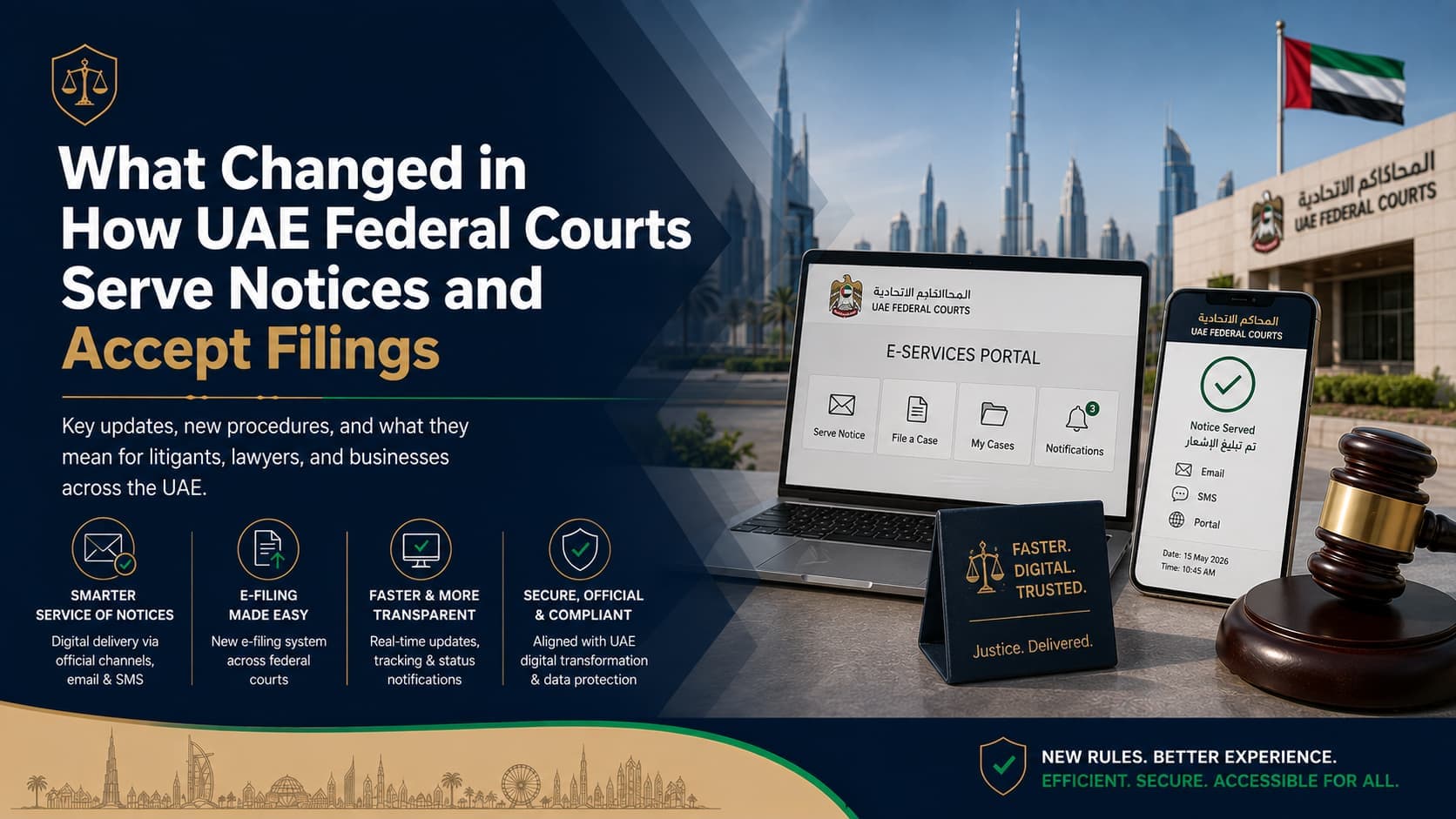
This article explains what changed in UAE federal courts' notice service and filing procedures following two sets of 2026 reforms: the January 2026 amendments to Federal Decree-Law No. 42 of 2022 (the Civil Procedure Law) through Federal Decree-Law No. 22 of 2025, which introduced mandatory e-filing, electronic service of process, specialised chambers for inheritance and complex commercial disputes, and tighter appellate thresholds; and the broader MoJ digital portal rollout that made e-filing the default channel for civil and commercial claims. The article covers what e-service and e-filing mean in practice, when each is mandatory versus optional, how process is served on individuals, UAE companies, and foreign defendants, what constitutes valid proof of service under the new framework, how contracts' notice clauses must be updated, and what the DIFC and ADGM exemptions mean.
Generated by AI · Not legal advice
- Electronic service of court documents is now expressly permitted under the 2026-amended Federal Decree-Law No. 42 of 2022 (Civil Procedure Law). Courts may direct service via the court electronic portal, certified SMS, or — where authorised — email to a contractually designated address.
- E-filing is mandatory for most civil and commercial claims in UAE federal courts and Dubai Courts from January 2026. Paper filing is no longer the default pathway.
- Federal Decree-Law No. 22 of 2025 (effective 1 January 2026) amended the Civil Procedure Law to introduce specialised chambers for inheritance disputes (constituted without party consent) and for complex civil or commercial cases (constituted on party request or agreement).
- Proof of service has shifted to digital evidence: court portal receipts, system-generated timestamps, delivery and read confirmations, and certified Ministry of Justice server logs are the primary evidence accepted.
- Contracts drafted before the 2026 reforms should be reviewed: notice clauses that reference only postal addresses or fax numbers may be insufficient to secure valid service under the new framework.
- Cross-border service still relies on diplomatic or bilateral channels — the UAE is not party to the Hague Service Convention — unless parties have contractually designated an in-country service agent.
- DIFC and ADGM courts are exempt from the federal e-service and e-filing rules and operate their own separate electronic filing and service regimes.
Quick Takeaways
- E-filing is now mandatory for most civil and commercial claims in UAE federal courts and Dubai Courts from January 2026. Paper filing is no longer the default.
- Electronic service of court documents is expressly permitted under the 2026-amended Civil Procedure Law — via the court portal, certified SMS, or court-authorised email.
- Federal Decree-Law No. 22 of 2025 (effective 1 January 2026) introduced specialised chambers for inheritance and complex commercial disputes — with tighter appellate rules and final-instance decisions.
- Proof of service has shifted to digital evidence: portal receipts, timestamps, and certified MoJ server logs are what courts now primarily expect.
- Contracts drafted before 2026 should be reviewed: notice clauses referencing only postal addresses or fax numbers may no longer secure valid service.
- Cross-border service still travels through diplomatic channels — the UAE is not party to the Hague Service Convention — unless parties designate an in-country agent by contract.
- DIFC and ADGM courts are exempt from the federal rules and operate their own separate electronic filing and service regimes.
Two Reforms, One Direction
The way UAE federal courts serve notices, accept filings, and verify that parties have received documents changed significantly at the start of 2026. Two overlapping legal developments drove the shift. First, the Ministry of Justice formalised mandatory e-filing across civil and commercial proceedings in federal courts and Dubai Courts, making the MoJ digital portal the standard channel for lodging claims, pleadings, and supporting documents. Second, Federal Decree-Law No. 22 of 2025 — which amends Federal Decree-Law No. 42 of 2022 on Civil Procedures and came into force on 1 January 2026 — embedded electronic service of process into the same framework, introduced specialised judicial chambers, and tightened the rules for appellate and cassation proceedings.
For businesses with UAE-governed contracts, litigants already in proceedings, and legal teams advising on disputes, the combined effect is immediate: the way you file, the way notice reaches a counterparty, and the evidence you need to prove that service happened have all changed. This guide explains exactly what is different, who it applies to, and what practical steps are needed.
The Legal Basis: Federal Decree-Law No. 22 of 2025
The primary civil procedure statute in the UAE is Federal Decree-Law No. 42 of 2022 on Civil Procedures. On 11 December 2025, the UAE government enacted Federal Decree-Law No. 22 of 2025, amending several provisions of that law. The amendments took effect on 1 January 2026 and operate across all federal and local onshore courts, including Dubai Courts and the Abu Dhabi Judicial Department, except for DIFC and ADGM, which have their own regimes.
The January 2026 amendments address four areas of civil procedure:
- Electronic service of process: courts may now direct service through the court’s own electronic system, including portal notifications, certified SMS, and court-authorised email.
- Specialised judicial chambers: new mandatory chambers for inheritance disputes and optional chambers for complex civil or commercial matters.
- Appellate and cassation procedure: appeals must be filed electronically at the Case Management Office or via the e-filing portal; non-compliance renders the appeal inadmissible.
- Expanded Public Prosecutor powers: the Attorney General may now file cassation petitions on their own initiative or at the request of the Minister of Justice, without a time limit on the institution of such petitions in certain categories.
E-Filing: What It Means and When It Is Mandatory
E-filing is the submission of claims, pleadings, and supporting documents through the court’s electronic portal. In UAE federal courts and Dubai Courts from January 2026, this is the default and expected method for most civil and commercial proceedings. A claimant who attempts to file a paper claim without prior court approval will generally have the filing rejected and directed to the MoJ portal.
Practically, e-filing through the MoJ portal works as follows:
- The claimant logs into the MoJ electronic filing system via UAE Pass or registered credentials.
- The claim, statement of claim, and all supporting documentation are uploaded in the required digital format (typically PDF with electronic signatures or attestation where required).
- The system assigns a case number automatically and issues a timestamped filing receipt. This receipt is the primary record of the filing date.
- All subsequent submissions — additional pleadings, evidence, expert reports, and applications — are uploaded through the same portal case file.
- Hearing notifications, case updates, and judgments are sent to the parties’ registered contact details through the portal.
For appellate proceedings, Federal Decree-Law No. 22 of 2025 added a specific requirement: appeals must be filed by a statement of appeal either at the Case Management Office or electronically through the portal. Non-compliance renders the appeal inadmissible. This closes off the old practice of filing paper appeals and having them accepted on the basis of procedural flexibility.
E-filing cannot be contracted out of. Parties cannot agree in their contract that court proceedings will be conducted by paper. However, a valid arbitration clause — such as a DIAC, ICC, or LCIA clause — redirects disputes away from court proceedings entirely. Court e-filing rules then apply only to ancillary applications, such as interim relief or enforcement of the arbitral award.
Electronic Service of Process: When and How It Works
Electronic service — e-service — is the delivery of court documents (statements of claim, hearing notices, orders, and judgments) to a party through a digital channel rather than by personal delivery or post. It is distinct from e-filing, though the two systems work together through the court portal.
Under the amended Civil Procedure Law, the court’s electronic system generates a notification to the party’s registered email address or mobile number. The system records the date and time of delivery and, where available, the date and time the notification was opened. This record is the primary proof of service for electronically served documents.
E-service is not automatic in every case. The court retains discretion over the service method, particularly where the defendant is outside the UAE, where electronic contact details are unknown, or where substituted service is appropriate. But in practice, courts increasingly default to electronic service for defendants whose contact details are on file, and a contract that designates a specific email address or portal identifier for service substantially increases the likelihood the court will authorise e-service.
Serving an individual resident in the UAE
The court’s preferred sequence under current practice: (1) electronic service via the court portal, with delivery recorded by system log; (2) personal service by a court-appointed process server at the individual’s residence or place of work; (3) if neither can be effected, substituted service — publication in two daily newspapers (one Arabic), notice affixed to the last known address, or any other method the court directs.
Serving a UAE company
Service on a UAE company follows a similar hierarchy: (1) service on the company’s registered agent or at its registered office, confirmed by a corporate registry extract from the relevant Department of Economy; (2) MOJ-facilitated electronic notification to the company’s registered contact details on file with the court; (3) service on a named director or authorised officer where the registered agent cannot be reached, supported by a power of attorney or board resolution confirming authority. Where a company has no registered agent and no electronic details on file, apply to the court for an order for substituted service, providing evidence of the steps taken.
Serving a foreign defendant
The UAE is not a signatory to the Hague Convention on Service Abroad. Cross-border service of UAE court documents therefore relies on diplomatic or consular channels or bilateral judicial cooperation agreements, a process that can take several months. The most efficient contractual alternative is to appoint an in-country agent for service of process in the contract itself — this avoids the delay inherent in diplomatic channels and gives the court a clear domestic address. The agent clause should name the agent, provide their UAE address, and state that service on the agent constitutes valid service on the foreign party.
Proof of Service: What UAE Courts Now Expect
Under the reformed framework, the primary proof of service for electronically served documents is digital:
- Court portal receipt: a system-generated document showing the case number, the document served, the recipient’s registered details, and the date and time of delivery.
- Delivery and read confirmations: where the system records whether and when the notification was opened, this log entry is admissible evidence of receipt.
- Certified MoJ server logs: for service directed through the MoJ’s electronic system, the Ministry can produce a certified extract of the delivery log, which courts treat as presumptive proof of service.
Traditional process-server affidavits remain valid but are now supplementary rather than primary. Where both electronic and personal service methods have been used, best practice is to file both the portal receipt and the server affidavit to remove any doubt.
If electronic service fails — the notification bounces or the system records no delivery confirmation — do not treat service as complete. Preserve all system logs showing the attempted delivery and error messages, attempt service by an alternative permitted method, and if all methods fail, apply to the court for a substituted service order before proceeding to the next hearing date. A default judgment obtained without valid service is vulnerable to being set aside.
The New Specialised Chambers
Alongside the e-filing and e-service changes, Federal Decree-Law No. 22 of 2025 introduced two categories of specialised judicial chamber:
Inheritance chambers
The President of the Federal Judicial Council or the head of a local judicial authority may now constitute specialised inheritance chambers by decision — without requiring the consent of the parties. These chambers have exclusive jurisdiction over wills, estate inventory and administration, liquidation, distribution among heirs, exclusion and inclusion of heir disputes, waqf (endowment) matters, and any civil, commercial, or real estate claims arising from or connected with the estate. Judgments from these chambers are generally final and not subject to ordinary avenues of appeal, with limited reconsideration procedures applying. The rationale is speed and finality in sensitive family-wealth disputes.
Specialised commercial and civil chambers
For complex civil or commercial disputes, specialised chambers can be constituted upon the request or agreement of the parties. These chambers are expressly empowered to appoint local and international experts, engage more rigorously with expert evidence, and direct the rectification or completion of expert reports. The same procedural rules otherwise apply. The intent is to concentrate technically demanding disputes before experienced dedicated benches rather than general chambers, and the trade-off is reduced appellate latitude — judgments carry greater first-instance finality.
What Changes for Contract Notice Clauses
The 2026 reforms have a direct effect on the enforceability of notice and service clauses in existing UAE-governed contracts. Any clause that refers only to postal addresses, fax numbers, or physical delivery may be insufficient to enable electronic service and could complicate a party’s ability to obtain court authorisation for e-service.
An updated notice clause should:
- Designate multiple channels — a physical address, an email address, and where available a court portal identifier for each party.
- Define deemed receipt — specifying when a notice is deemed received (for example: on the date shown by the system delivery confirmation, or 24 hours after sending for email).
- Include an update obligation — requiring each party to notify the other of any change to their service address or email within a specified period, and providing that service to the last notified address remains valid.
- Address escalation — providing that if electronic delivery fails, the sending party may serve by courier or registered post to the physical address, effective on delivery or attempted delivery.
- For contracts with foreign counterparties: designate an in-country UAE service agent, naming them by full name and address, and stating that service on the agent constitutes valid service on the foreign party. This is the single most effective way to avoid the months-long diplomatic service channel.
DIFC and ADGM: Separate Rules Apply
The DIFC Courts and ADGM Courts are not governed by Federal Decree-Law No. 42 of 2022 or the 2026 amendments. They operate under their own procedural rules and electronic filing and service regimes. For service of process via the DIFC Courts, practitioners must comply with Part 9 of the DIFC Court Rules, which permits service by email where the court is satisfied the method will bring the document to the defendant’s attention. The ADGM Courts operate a broadly similar regime under the ADGM Court Procedure Rules. Parties litigating in those forums should not assume the federal e-service framework applies.
Frequently Asked Questions
Is electronic service of court documents now permitted in UAE federal courts?
Yes. The January 2026 amendments to Federal Decree-Law No. 42 of 2022 expressly permit electronic service via the court’s electronic portal, certified SMS, or — where the court specifically authorises it — email to a contractually designated address. The court’s system records the date and time of delivery and, where available, the time of opening.
Is e-filing mandatory in UAE courts in 2026?
Yes, for most civil and commercial claims in federal courts and Dubai Courts. Paper filing without prior court approval will generally be rejected. Appellate submissions must also be filed electronically — non-compliance renders the appeal inadmissible. Arbitration proceedings are not subject to court e-filing rules, though ancillary court applications are.
Can UAE court documents be served by email alone?
Not automatically. Email service requires court authorisation. It is typically permitted where the contract designates a specific email address for service or the defendant has previously used that address in proceedings. Designating an email address in your contract is the most reliable way to facilitate this.
What counts as valid proof of service in UAE courts after the 2026 reforms?
Courts primarily accept: court portal receipts with timestamps; system-generated delivery and read confirmation logs; and certified MoJ server log extracts, which are treated as presumptive proof. Traditional process-server affidavits remain valid but are supplementary.
How does cross-border service of UAE court documents work?
The UAE is not party to the Hague Service Convention. Cross-border service relies on diplomatic or consular channels, bilateral judicial cooperation agreements, or a contractually appointed in-country service agent. The agent route is the most practical — it avoids diplomatic delays that can run to several months and gives the court a clear domestic address for service.
What are the new specialised chambers introduced by the 2026 civil procedure reforms?
Federal Decree-Law No. 22 of 2025 introduced: (1) inheritance chambers, constituted without party consent, with exclusive jurisdiction over estates, wills, distribution, and related commercial claims; and (2) specialised commercial and civil chambers, constituted on party request or agreement, with enhanced expert powers. Judgments from both types of chamber are generally final, with limited appeal avenues.
Do the 2026 UAE e-filing and e-service rules apply to DIFC and ADGM courts?
No. DIFC and ADGM courts operate under their own procedural rules and electronic filing and service regimes — the federal framework does not apply. Practitioners in those forums should follow the DIFC Court Rules (Part 9 for service) and ADGM Court Procedure Rules respectively.
What to Do Now
The 2026 reforms represent the most significant procedural shift in UAE civil litigation in a generation. The direction is clear: digital by default, with paper as the exception. For businesses with active UAE-governed contracts, the immediate practical tasks are to review and update notice and service clauses, designate email addresses and where applicable in-country agents for service, and make sure litigation teams understand that portal receipts — not affidavits — are now the primary proof of service. For those already in proceedings, confirm that all filings have been lodged through the MoJ portal, retain all system-generated receipts, and ensure that any appeals are filed electronically in compliance with the new requirements.
References
- Global Law Experts. Service of Process in the UAE After the 2026 Reforms. June 19, 2026.
- BSA Law. UAE Civil Procedures: What the 2026 Reforms Mean for You. January 28, 2026.
- Kashwani Law Firm. Federal Decree-Law No. 22 of 2025 Amending the Civil Procedures Law. 2026.
- Zawya / UAE Government. UAE government issues Federal Decree-Law amending the Civil Procedures Code. December 11, 2025.
- UAE Ministry of Justice. e-Filing System. moj.gov.ae.
Related Guides
UAE Court and Police Case Check — check whether a case has been filed against you in the UAE court system before proceedings are served.
UAE Travel Ban Check — court proceedings can result in travel restrictions; check your status if a case has been or may be filed.
Lawyer in Dubai — find representation for UAE court proceedings under the new e-filing rules.
UAE Bankruptcy Law 2024 — if insolvency proceedings are involved, the Bankruptcy Court operates within the same digital litigation framework.
George Mathew is the Co-founder and Senior Litigation Counselor at Wirestork, a legal technology company he established in 2017 to make GCC legal processes more accessible and affordable for expatriates and businesses. With deep expertise in UAE and Saudi Arabia law — covering travel bans, immigration, court cases, and debt resolution — George has overseen more than 100,000 legal checks across the GCC region. His work bridges the gap between complex legal systems and the everyday needs of expats navigating the UAE and Saudi legal landscape. He is based in the UAE and consults regularly on
Share this article
Stay informed.
Receive important legal and regulatory updates across the UAE, Saudi Arabia and the wider GCC.
No spam. Unsubscribe anytime.
Continue Reading
More Legal Insights
UAE Unlimited Contract Abolished: What It Means for Employers and Employees in 2026
UAE unlimited employment contracts were abolished by Federal Decree-Law No. 33 of 2021, ef…
Saudi Work Permit Cancelled After 3 Months' Absence (2026 Qiwa Rule)
From June 30, 2026, Saudi Arabia automatically cancels Qiwa registration for non-Saudi wor…
Qiwa Contract Limit 2026 & Saudi Work Visa Quotas: Nitaqat Overhaul Explained
The Qiwa platform caps Saudi nationals at seven employment contracts per year and two simu…