
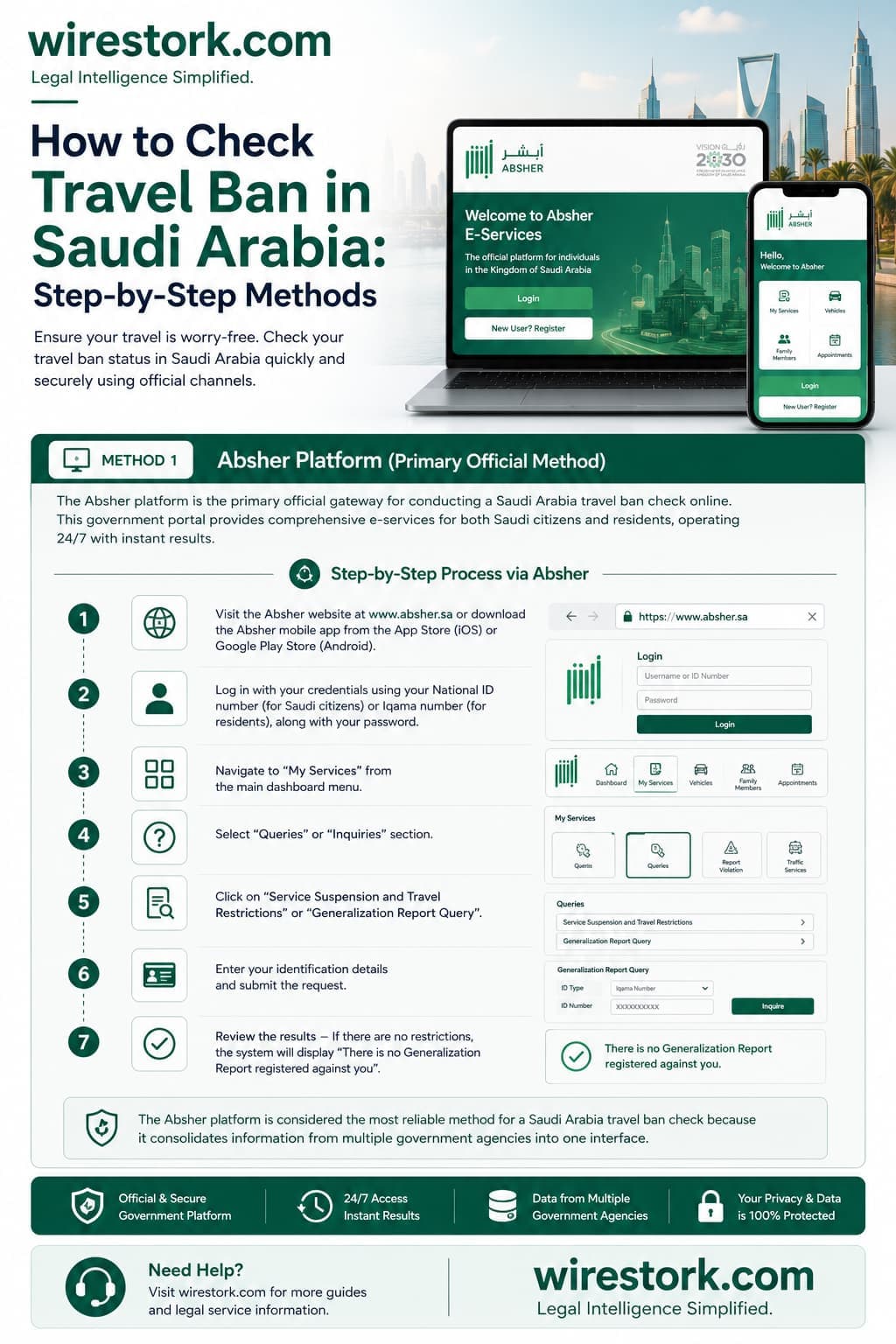
Checking for a Saudi Arabia travel ban starts with Absher for most people, but Absher isn't the whole picture - court-related bans in particular need a cross-check through Najiz or the Ministry of Justice portal, which hold case-specific detail Absher's summary view often leaves out. This guide walks through every official method, the main categories of ban, and the exact steps to resolve each one.
Legally reviewed by George Mathew, Co-founder & Senior Litigation Counselor, Wirestork — overseeing more than 100,000 legal checks across the GCC region.
Need to check your ban using a passport number? See our step-by-step guide on how to check a Saudi Arabia travel ban with your passport number covering Absher, Najiz, Muqeem, and what to do when you're outside the Kingdom or have no Iqama.
This guide explains how to check for an active Saudi Arabia travel ban through Absher, Muqeem, and the Ministry of Justice/Najiz portal, covering the main ban categories (financial, Huroob/labour, criminal, civil, immigration), the DIY-vs-professional decision, and the step-by-step removal process for each ban type. It distinguishes individual travel-ban-check intent from the separate 2025 Hajj-season short-term visa moratorium news story.
Generated by AI · Not legal advice
- Absher is the primary and fastest official method to check for a Saudi Arabia travel ban, but it does not capture every restriction - Najiz and the Ministry of Justice portal hold case-specific detail Absher's summary view often omits.
- Financial disputes are widely reported as the most common cause of Saudi travel bans, though an independently verifiable, current percentage is not publicly available - treat specific percentage figures with caution.
- Ban types (financial, Huroob/labour, criminal, civil/family, immigration) each require a distinct resolution pathway - identifying the issuing authority is the first step to resolving any ban.
- The 2025-2026 Hajj-season short-term visa suspension affecting several nationalities is a separate, temporary government policy - not an individual travel-ban-check result - and should not be confused with a personal restriction.
- A professional multi-database check adds value specifically where Absher alone is insufficient: no active account, court filings not yet synced, or a need for documentation suitable for formal use.
Quick Takeaways
- Absher is the primary, free, instant method to check your status - start here.
- For court-related bans, cross-check through Najiz, which surfaces case number, court, and petitioning party detail Absher often doesn't.
- No automatic notification exists - authorities do not proactively inform you of a restriction, so periodic checking is genuinely necessary, not just precautionary.
- Financial disputes are widely reported as the most common cause of travel bans, though a precise, independently verifiable current percentage is not publicly available.
- Resolution is possible for most bans - the path depends entirely on which authority issued it.
Latest Update: 2025 Hajj-Season Visa Suspension Is Not an Individual Travel Ban
If you've searched for "Saudi Arabia visa ban" alongside a specific nationality, you may be looking for a different story: in 2025, Saudi Arabia introduced a temporary suspension of certain short-term visa categories (including Umrah, business, and tourist visas) during the Hajj season for nationals of several countries, including India, Egypt, Pakistan, Yemen, Tunisia, Morocco, Jordan, Nigeria, Algeria, Indonesia, Iraq, Sudan, Bangladesh, and Libya, effective from mid-April 2025. This is a temporary, nationality-based policy measure tied to Hajj crowd management - it is not the same as an individual travel ban tied to your personal legal or financial status, and checking Absher will not show a country-level visa policy. If you're trying to confirm your own personal ban status rather than this policy, continue to the check methods below.
Understanding Saudi Arabia's Legal System
The Challenge of Decentralised Data
Saudi Arabia's legal system combines Sharia law with modern statutory codes covering labour, immigration, and finance. Sharia courts operate alongside specialised courts (labour courts, criminal courts, execution courts), each with jurisdiction over specific matters. Unlike countries with a single unified case database, Saudi Arabia's system is genuinely decentralised, and no single platform captures every possible restriction. Key institutions involved:
- Jawazat (General Directorate of Passports) - immigration-related bans, visa violations, border control
- Ministry of Human Resources and Social Development (MHRSD) - labour-related bans and Huroob status
- Ministry of Justice / Najiz - court-imposed civil and criminal travel restrictions, with case-level detail
- Ministry of Interior - overall security-related travel restrictions
- Communications and Information Technology Commission (CITC) - can recommend restrictions in telecom-related fraud cases
Common Reasons for a Saudi Arabia Travel Ban
Financial Disputes
Financial disputes - unpaid loans, credit card debt, and bounced cheques - are widely reported as the most common category of Saudi travel ban, though a precise, independently verifiable percentage isn't publicly available and should be treated as an approximation rather than a hard figure. Even debts as small as SAR 10,000-15,000 have been reported to trigger a restriction once a judgment is obtained. Banks and courts can request a ban once internal recovery efforts have failed.
Huroob (Absconding Report)
Huroob (هروب) refers to an employer's formal report that a worker has fled or absconded from their job. Once filed, the reported individual can face a travel ban and possible arrest, and re-entry restrictions are commonly reported in the range of several years. A Huroob report can be filed correctly or, in disputed cases, incorrectly - either way it is challengeable through MHRSD.
Labour Disputes
Contract breaches, disputed final settlements, or unauthorised work activity can lead employers to request a labour-related ban through MHRSD, separate from a formal Huroob filing.
Criminal and Civil Court Cases
Pending criminal investigations or trials commonly trigger a restriction to keep the accused available for proceedings, remaining active until the case concludes or the court grants permission to travel. Civil matters - child custody, divorce, property division - can similarly result in a ban intended to protect the interests of all parties until judgment or settlement.
Telecom/SIM Registration Fraud
A growing category involves SIM cards fraudulently registered under someone's Iqama or National ID without their knowledge, followed by unpaid bills accumulating on that account - which can, in turn, trigger a travel restriction the affected person never caused. The CITC has introduced verification services allowing residents to check for unauthorised SIM registrations under their name via SMS through their carrier. Because this only covers the carrier a subscriber is registered with, checking with other networks separately is worth doing if fraud is suspected.
Political or Public-Expression-Related Bans
Bans have also been publicly reported in connection with online activism and public criticism of authorities, sometimes alongside lengthy prison sentences reported by international human rights organisations. This category is legally and practically distinct from the financial, labour, and civil bans covered elsewhere in this guide, and resolution options are correspondingly different and often more limited.
How to Check: Every Official Method
Method 1 — Absher (Start Here)
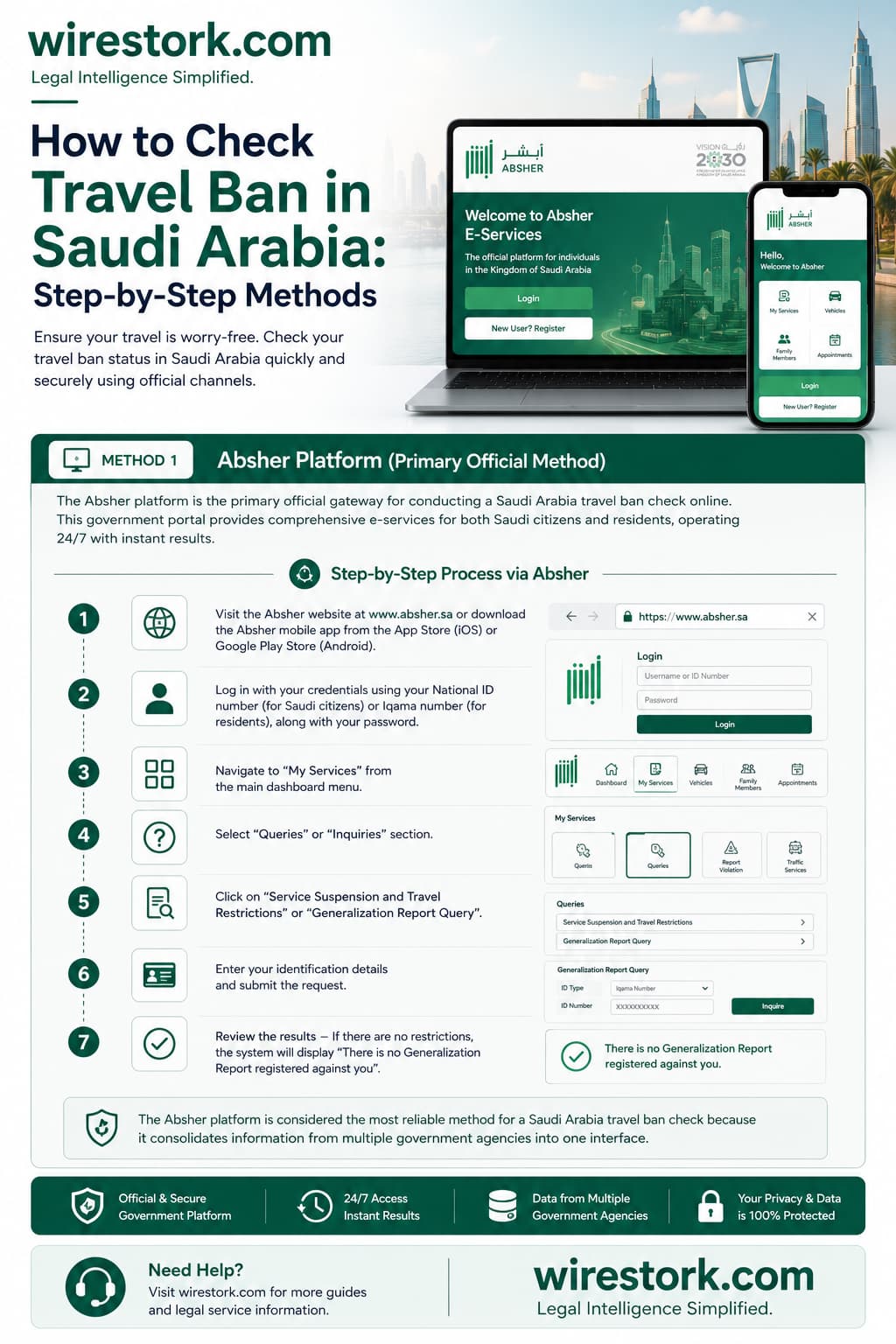
Visit absher.sa or open the mobile app. Log in with your National ID (citizens) or Iqama number (residents) and password. Navigate to My Services → Queries, then select "Generalization Report Query" or "Travel Ban Inquiry." Submit and review the result. If the system shows no report, you have no restriction registered in Absher specifically - remember this doesn't rule out a case that hasn't synced yet.
Method 2 — Najiz / Ministry of Justice Portal (For Court-Related Bans)
%20Portal.jpg)
If Absher shows a restriction tied to a court, or you specifically suspect a debt or civil-dispute ban, cross-check through najiz.sa or the Ministry of Justice's Electronic Services using your National ID or Iqama number. This is genuinely the more useful platform for anyone who already knows or suspects a court is involved - it's where you find out which creditor or court to actually contact, not just that a restriction exists.
Method 3 — Muqeem Portal (For Expatriates)
Muqeem (muqeem.sa) is aimed specifically at residency and Iqama-linked services for expatriates, including exit/re-entry visa validity and travel restrictions tied to residency status. Enter your Iqama details and check the travel restrictions section.
Method 4 — Direct Visit to a Government Office
For in-person verification, visit a Jawazat office, the General Court, Labor Court, or Execution Court with your original ID documents. Staff can provide detailed case information including outstanding amounts and specific next steps directly.
Method 5 — Saudi Embassy or Consulate (From Abroad)
If you're outside Saudi Arabia and need to check before re-entering, contact the nearest Saudi embassy or consulate with your Iqama number, passport number, and relevant identification details. This route is slower than the online platforms but can provide written confirmation useful for formal purposes.
Method 6 — Professional Multi-Database Verification
If you no longer have active Absher access - common for former residents whose Saudi mobile number has been deactivated - or if you need documentation suitable for a visa or employment application, a professional verification service can run a consolidated check across Jawazat, MHRSD, and civil court records without requiring active Absher credentials.
DIY vs. Professional Check: Which Do You Actually Need?
Absher/Muqeem/Najiz (DIY)
- Free, instant, self-service
- Requires an active Absher account and access to your registered Saudi mobile number
- Best when you're a current resident checking your own routine status
- Limitation: may not reflect very recent filings or cases not yet uploaded to the central system
Professional Multi-Database Check
- Useful when you have no active Absher access, are checking from abroad, or need formal documentation
- Checks across court, labour, and immigration records in a single consolidated report
- Paid service - confirm current pricing and turnaround directly with the provider before proceeding
- Best when the stakes are high: an imminent trip, a return visit after a prior dispute, or a complex employment history in the Kingdom
In short: if you're a current resident with active Absher access and no reason to suspect a complicated history, DIY is genuinely sufficient. If any of those conditions don't hold, a professional check closes the gap. For a fuller cross-database check, Wirestork's Saudi Arabia travel ban check service is available.
Consequences of an Unresolved Travel Ban
- Detention at the border: exit points have real-time database access; attempting to travel with an active ban typically results in immediate detention.
- Extended legal proceedings: resolution can take anywhere from days (simple settlements) to months (contested court cases).
- Employment and travel disruption: missed business commitments, breached contractual travel obligations, and future visa complications in the Kingdom or wider GCC.
How to Resolve or Remove a Travel Ban
Financial Bans
Confirm the exact outstanding amount with the creditor. Negotiate settlement terms in writing before paying. Pay through an official channel and keep receipts. Take the settlement documentation to the issuing court, which processes the closure and requests removal - typically reflected within a few business days. Always verify the ban is actually lifted through Absher or Najiz before booking travel.
Huroob and Labour Bans
MHRSD offers mediation that resolves many disputes without a full court process. Gather documentation - contract, payment records, correspondence. If Huroob was filed without valid grounds, file a formal objection through MHRSD; the employer can be ordered to retract it. Where mediation fails, the Labor Court generally moves faster than general courts.
Criminal and Civil Cases
Engage qualified legal representation familiar with Saudi court procedure. Attend every required hearing. In civil disputes, out-of-court settlement is often the fastest resolution. For urgent travel needs, courts can sometimes grant limited temporary permission subject to a deposited guarantee.
Government Contact Directory
- Absher (Ministry of Interior) — absher.sa | 920020405
- Najiz / Ministry of Justice — najiz.sa, moj.gov.sa | 1950
- Ministry of Interior (General) — moi.gov.sa | 911 (emergency) / 999
- Muqeem Platform — muqeem.sa
- Riyadh General Court — King Fahd Road, Al-Adl District | +966 11 411 8888
- Jeddah General Court — Al-Ruwais District | +966 12 665 1111
- Dammam General Court — Al-Mazruiyah | +966 13 833 3333
Preventing a Travel Ban
- Keep dated records of every debt payment and financial obligation
- Contact creditors proactively before matters reach a court filing
- Complete proper exit procedures and obtain an NOC when changing jobs
- Respond promptly to any legal notice or court summons
- Verify no SIM cards are registered in your name that you didn't authorise
- If leaving permanently, settle balances, close accounts, and obtain clearance letters before departure
Related GCC Guides
- How to check a travel ban in the UAE
- Checking a labour ban in the UAE
- How to check a police case in the UAE online
- GCC travel ban checks across multiple countries
Frequently Asked Questions
How do I check if I have a travel ban in Saudi Arabia? Start with Absher (absher.sa) using your National ID or Iqama number for an instant baseline check. For court-related or financial bans, cross-check through Najiz.
What's the difference between Absher and Najiz? Absher shows whether a restriction exists and its general issuing authority. Najiz shows case-specific detail for court-related bans - the case number, court, and petitioning party.
How long does it take for a ban to lift after settling a debt? Once settlement documentation reaches the issuing court, removal is typically reflected within a few business days, though this varies. Always verify independently before booking travel.
Can I check my status if I no longer have Absher access? Yes - Najiz can be accessed with a National ID or Iqama number, and professional verification services can check without active Absher credentials.
Does Absher show every type of ban? No. Court filings, Huroob complaints, and some police cases can trigger a restriction without appearing on Absher immediately.
Can an employer place a ban on me without my knowledge? Employers cannot impose a ban directly, but they can request one through labour authorities or file a Huroob report - the actual restriction is issued by government authorities after the employer's petition, and you may not be notified in advance.
What's the difference between an exit ban and a re-entry ban? An exit ban prevents you from leaving Saudi Arabia and applies to current residents. A re-entry ban prevents you from entering, typically tied to a prior immigration violation or deportation. Both can apply simultaneously in some cases.
Is checking my travel ban status free? Yes, via Absher, Najiz, and other official government platforms. Professional verification services charge for comprehensive multi-agency checks and documentation.
Is the 'Saudi Arabia visa ban Pakistan' news story the same as a personal travel ban? No. That refers to a temporary, nationality-based short-term visa suspension tied to Hajj-season crowd management, distinct from an individual restriction tied to your personal legal or financial status.
Are Saudi travel bans permanent? Most are not and can be lifted once the underlying issue is resolved, though serious criminal matters or repeated violations can result in longer restrictions. Regular checking helps track resolution progress.
Key Takeaways
- Start with Absher for a fast baseline check; cross-check with Najiz for anything court-related.
- Ban categories - financial, Huroob/labour, criminal, civil, immigration - each have a distinct resolution path.
- Verify a ban is actually lifted through Absher or Najiz after resolving it - don't assume paperwork alone updates the system immediately.
- The 2025 Hajj-season visa suspension is a separate policy story, not an individual ban result.
Conclusion
Checking for a Saudi Arabia travel ban genuinely starts with Absher, but treating it as the complete picture is where people get caught out - especially for court-related and financial bans, where Najiz holds the case-specific detail that actually tells you how to resolve things. Whichever type applies to your situation, the path forward is largely the same: confirm the specific cause and issuing authority, address it through the right channel, and independently verify the ban is actually cleared before you rely on it.
References
- Ministry of Interior, Saudi Arabia — Absher Platform
- Ministry of Justice, Saudi Arabia — Najiz Portal
- Ministry of Human Resources and Social Development — MHRSD Services
- U.S. Department of State — Saudi Arabia Travel Advisory
- Government of Canada — Travel Advice for Saudi Arabia
This article is provided for general information purposes only and does not constitute legal advice. Laws and procedures in Saudi Arabia are subject to change. For situation-specific guidance, consult a qualified legal professional licensed to practise in Saudi Arabia. Wirestork is an online legal technology service, not a law firm.
Check your Saudi travel ban status
Verify travel bans and Absher restrictions in Saudi Arabia.
Check Travel BanPriya Nair covers UAE immigration, residency, and expatriate employment law. She monitors visa policy updates from the ICP, MOHRE, and GDRFA, and writes practical guides for individuals navigating Golden Visas, work permits, family sponsorship, and the evolving freelance licensing landscape.
Share this article
Stay informed.
Receive important legal and regulatory updates across the UAE, Saudi Arabia and the wider GCC.
No spam. Unsubscribe anytime.
Continue Reading
More Legal Insights
UAE Unlimited Contract Abolished: What It Means for Employers and Employees in 2026
UAE unlimited employment contracts were abolished by Federal Decree-Law No. 33 of 2021, ef…
Saudi Work Permit Cancelled After 3 Months' Absence (2026 Qiwa Rule)
From June 30, 2026, Saudi Arabia automatically cancels Qiwa registration for non-Saudi wor…
Qiwa Contract Limit 2026 & Saudi Work Visa Quotas: Nitaqat Overhaul Explained
The Qiwa platform caps Saudi nationals at seven employment contracts per year and two simu…